Alhambra Wood Flooring installs wide plank flooring in Alhambra, CA, bringing more than 20 years of wood floor experience to a style that is less forgiving than it looks. Wide boards show off grain and create a calm, open look across a room, but they also magnify every mistake in the subfloor, the moisture readings and the fastening, and those mistakes show up as cupping, gaps and squeaks within a season or two.
Our approach is to treat the preparation as the main job. We check the subfloor from above and from the crawl space on raised houses, test moisture in the wood and on any slab, and choose a board construction that suits the house, all before a single plank is ordered. That groundwork is what lets a wide plank floor stay flat and tight for the long term.
Choosing Wide Plank Boards
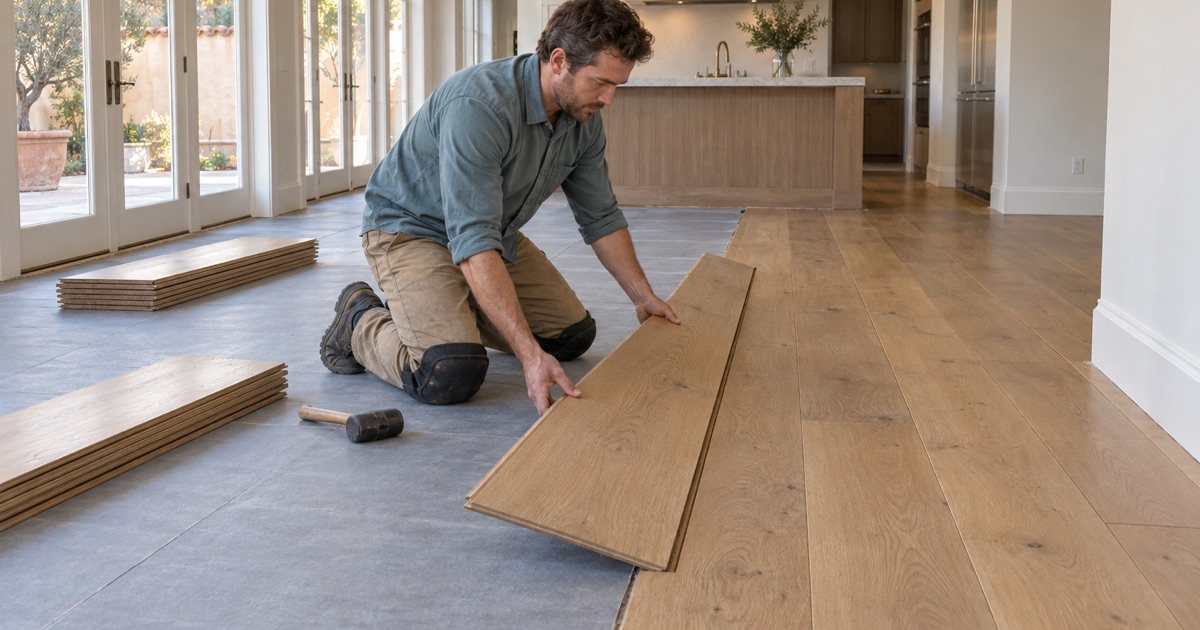
Solid Wide Planks
Solid wide planks are milled from a single piece of wood, so they can be sanded and refinished many times over their life. Their weakness is movement: a wide solid board swells and shrinks across its width with every seasonal change, and it is more prone to cupping if moisture reaches it from below. Over a sound plywood subfloor in a house with stable humidity, solid planks can perform beautifully when installed with care.
Engineered Wide Planks
Engineered planks bond a real hardwood wear layer to a cross-layered core that resists expansion and contraction. That stability makes engineered construction the usual choice for the widest boards and for installation over concrete slabs. The tradeoff is the wear layer: we look at its thickness before you buy, because it decides whether the floor can be fully sanded later or only screened and recoated.
Species, Cut And Surface Texture
White oak is the most common wide plank species for its stability and tight, even grain, while hickory offers a harder surface with bold color variation. Quartersawn and rift sawn boards move less across their width than plainsawn boards, which helps wide planks stay flat. Wire-brushed surfaces add texture that hides everyday scratches, though they also change how the floor can be refinished in the future.
Preparing The Subfloor For Wide Boards
Flatness Over The Whole Room
Narrow strip flooring can ride over small dips and humps in a subfloor, but long wide planks cannot. They rock over high spots, sound hollow over low spots, and telegraph every irregularity once a raking light hits them. We check flatness across the room with a long straightedge, grind or sand down high areas, and fill low areas before installation starts.
Moisture Testing And Acclimation
Because wide boards react so strongly to moisture, testing matters more than on any other installation. We compare moisture readings between the planks and a wood subfloor, and on a slab we use in-situ relative humidity testing to confirm the concrete is ready. Planks are acclimated in the home until readings show they are within an appropriate range, rather than simply left for a set number of days.
Crawl Space Conditions On Raised Houses
On a raised foundation, a damp crawl space can keep the underside of a wood floor wetter than its surface, which is exactly the condition that cups wide boards. We check for leaks, standing water and bare soil under the house, and recommend fixing drainage or adding a crawl space vapor barrier where needed before the new floor goes in.
We also look at the framing while we are under the house. A bouncy span or a sagging joist that a narrow strip floor might have hidden will show up as movement and noise under long, wide boards, so any sistering or blocking the floor needs is done before installation rather than after the first complaint about a soft spot in the middle of the room.
Installing And Finishing Wide Plank Floors
Glue-Assisted Nail-Down And Glue-Down Methods
Wide solid planks over a wood subfloor are usually installed nail-down with adhesive added underneath, which helps hold the broad boards flat as they move. Fastener spacing and cleat or staple choice follow the width of the board. Engineered wide planks over concrete are generally glued down with full adhesive coverage, since gaps in the adhesive create hollow spots that are especially noticeable under wide boards.
Layout, Board Mixing And Expansion Space
With fewer boards in the room, each plank has more visual weight, so we lay out rows to avoid awkward narrow rips along walls and distribute color and grain by mixing boards from several boxes. End joints are staggered so no pattern repeats across the floor. Expansion space at the walls is sized for the greater seasonal movement of wide boards and covered by baseboard or shoe molding.
Low-Sheen Finishes That Show The Grain
On site-finished wide plank floors, a low-sheen waterborne polyurethane or a hardwax oil lets the grain across each plank show without glare, and hardwax oil allows spot repair in busy areas. Every finish we apply meets the South Coast air district’s 275 grams per liter limit for wood coatings, and your schedule shows when each room can return to everyday use.
- 20+ Years in Wood Flooring
- Free Written Estimates
- Room-by-Room Schedules