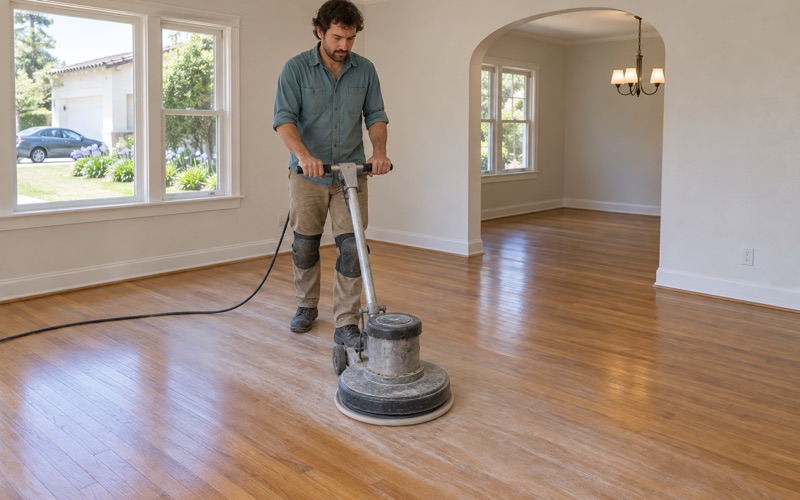
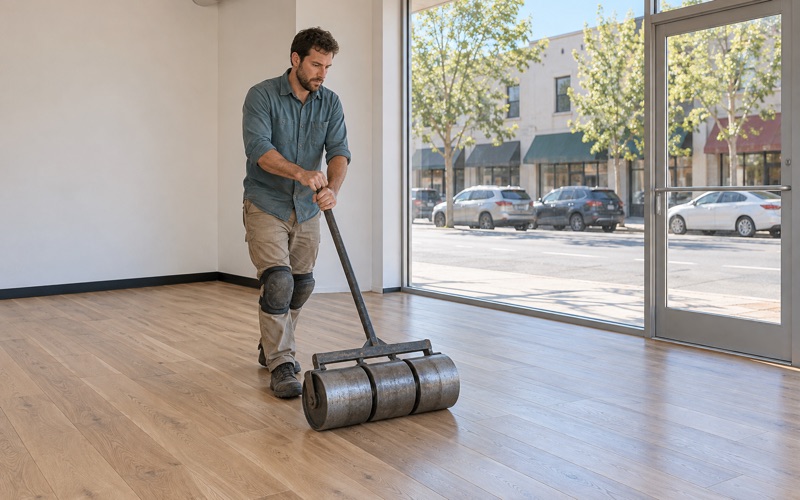
Alhambra Wood Flooring brings more than 20 years of hands-on work to wood-flooring in Sierra Madre, from a screen and recoat on a lightly worn finish to full sanding, board replacement, stair work and new solid or engineered hardwood. We start with the floor that is actually there, not with a package price, because an older floor can hold surprises that change the right answer.
Before any sanding is scheduled, we confirm the build year, measure the wear layer on engineered boards and look for drywood termite evidence. A thin veneer can take a screen and recoat but not a full sand, and small round holes with pellet piles beside them need to be identified or ruled out before a single board comes up.
Each quote comes with a written room-by-room schedule showing when you can walk on each room, when rugs and furniture can go back and when pets can return. Owners, landlords and tenants all plan around cure time, and a schedule on paper is easier to plan around than an estimate given at the door.
Floors in a Village That Rarely Builds New
A Housing Stock Lived On for Decades
Sierra Madre, known as the Village of the Foothills, has added very little housing in recent decades. The Census Bureau’s American Community Survey (2024 five-year estimates) counts 4,977 housing units in the city, and only 294 of them, 5.9 percent, were built in 2000 or later. Just over half, 51.2 percent, were built before 1960.
That age tends to show up in the floor itself. A board that has been sanded several times has less wood above the tongue, older repairs rarely match the field around them, and years of seasonal gapping and compression set leave joints that open wider each dry season. We read those signs before deciding whether a floor wants a full sand or a lighter pass.
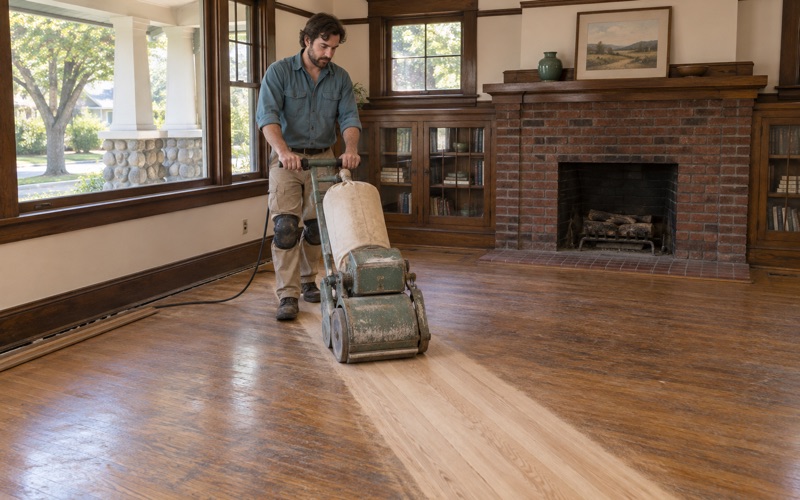
Past refinishing leaves its own record, too. Drum marks, chatter marks and edger swirl from an earlier sanding, or a sand-through spot near a threshold, tell us how much wood a previous crew took off and how carefully the next pass has to go.
Build Year and Old Finish Layers
Of those older units, 875, or 17.6 percent of the total, date to 1939 or earlier, and a floor that old may carry finish layers from several eras. With so much of the town built before 1978, we confirm the build year before sanding is scheduled. Pre-1978 paint and finish layers are handled under the EPA Renovation, Repair and Painting Rule.
That rule shapes how dust is contained, collected and cleaned up, and on an older floor containment also protects the rooms we are not working in. Finishes come from products legal to apply in the South Coast air district, where SCAQMD Rule 1113 sets the wood coatings limit at 275 grams per liter, rather than from a national catalog.
Landmark Status Is the Owner’s Choice
Sierra Madre adopted its historic preservation ordinance in 1987, and since a 1997 amendment a property becomes a local landmark only with the owner’s consent. Landmark status here is a decision a household makes, not a label that arrives with the address. Owners of local landmarks receive a waiver of city permit and plan check fees.
The Mills Act is a separate question. Eligibility is limited to City Historic Landmarks, and the City Council has suspended new Mills Act applications pending a review of existing contracts. The city’s program page does not address interior alterations, so a landmark owner planning floor work should confirm the scope with the Planning and Community Preservation Department before any material is ordered.
Looking for wood-flooring closer to La Cañada Flintridge? See Wood-Flooring in La Cañada Flintridge.
Working in Lower and Upper Sierra Madre Canyon
Small Bungalows and Cabins
Lower and Upper Sierra Madre Canyon are the part of town with narrow, winding roads, lush vegetation and small bungalows or cabins. A small house does not make a simple floor job. In a compact plan where one room opens straight into the next, the schedule has to route foot traffic around wet finish rather than just closing a door.
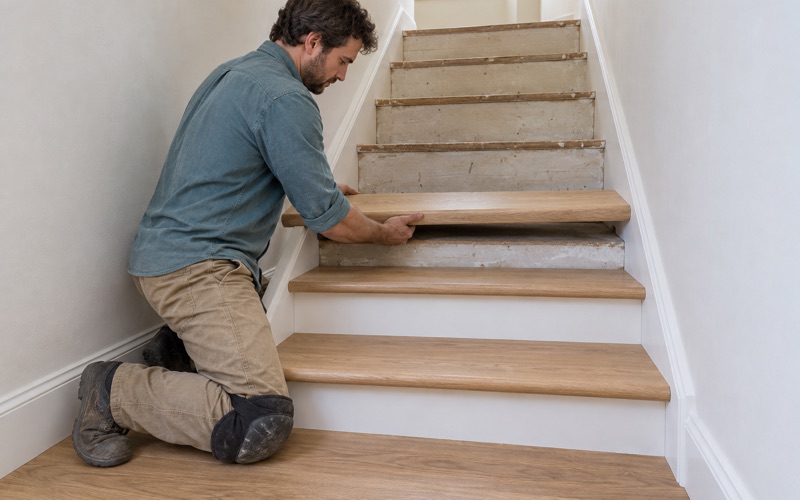
We do not assume how any canyon house was built or what is under its floor. Species, subfloor and past repairs are confirmed on site, and the quote is written room by room, with stairs priced by the tread, riser and nosing rather than folded into a square-foot figure, because stair work is built differently from open floor.
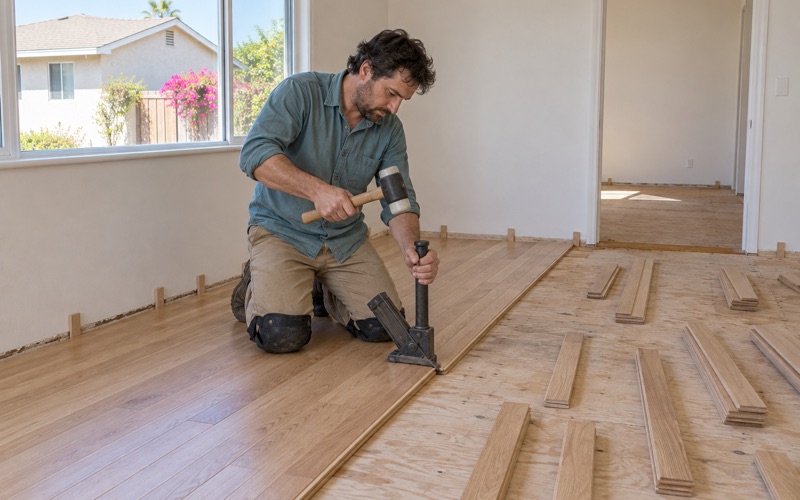
Foothill seasons matter to wood as well. Sierra Madre sits in National Weather Service forecast zone CAZ548, Los Angeles County San Gabriel Valley, and boards shrink and swell as relative humidity rises and falls through the year. New flooring is acclimated in the house and checked with a moisture meter against the subfloor before installation, with an expansion gap left at the walls.
Looking Underneath Before Quoting
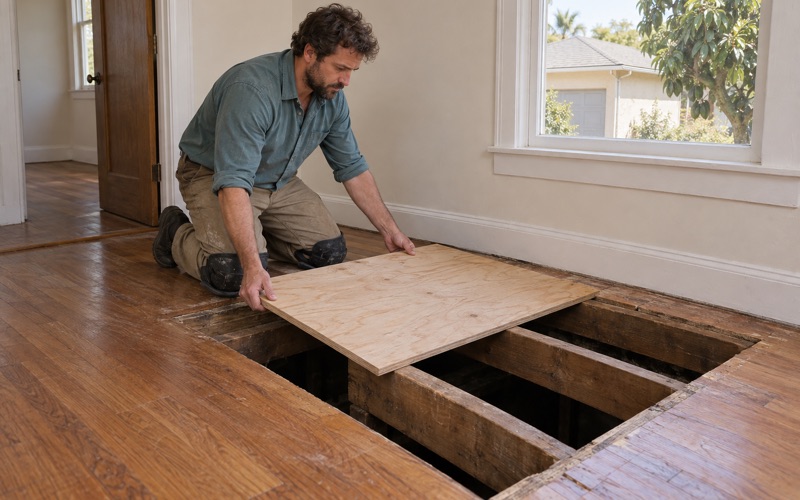
Where a home has a raised floor over a crawl space, we look underneath before a price is written. A sagging floor, a bouncy floor or a soft spot is often a floor joist, pier post or subfloor problem, and sanding the surface would only hide it until the next season.
What we find sets the order of work. A cracked girder or a failing post may call for a sister joist or new support before any board is touched, and a damp crawl space may need its vapor barrier addressed first. Where a house sits on slab-on-grade instead, we test the slab for moisture before any wood goes down.
Termite Evidence and Matching Boards
Drywood termites leave small round kick-out holes and piles of pellet-shaped frass. We identify that evidence or rule it out before a board is replaced, so new wood does not go down over an active colony. If a Wood Destroying Pests and Organisms Inspection Report already exists, we read it alongside our own look at the floor.
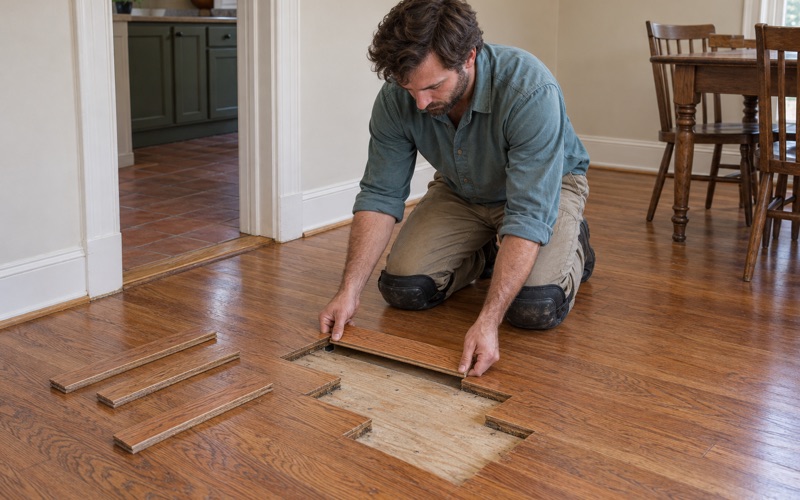
Replacement boards are woven into the existing field rather than set in as a patch. A weave-in repair staggers new board ends among the old ones, matched as closely as the existing species, width and grain allow, so the repair does not read as a rectangle once the whole floor is sanded and finished.
Refinishing Between Tenants in Small Apartment Buildings
A Town With a Real Renter Share
Of Sierra Madre’s 4,620 occupied units, 2,041, or 44.2 percent, are renter-occupied. Among renter households, 45.7 percent live in buildings with five or more units, and all 420 households in the city’s ten-to-nineteen-unit buildings rent. Floor work here is not only a homeowner’s project; it can just as easily belong to the owner of a small walk-up building.
For those owners, refinishing usually has to fit the gap between one tenancy and the next. That window is short and fixed, so we schedule sanding, each coat and the cure time around the move-out and move-in dates. We plan the order of rooms so finish is never drying across the only route to a space someone still needs.
Condition Recorded on Both Sides
We record the floor at move-out with photos, noting pet urine stains, gray stains, worn-through finish, dents and scratches. That record helps a landlord separate normal wear and tear from damage that may support a security deposit deduction, and it leaves both sides with the same documented starting point.
The floor is recorded again once work is done and before the next move-in. A pet urine stain that has gone deep enough to become a black water stain often means board replacement, while a lighter gray stain may sand out, and the photos show which repair each spot actually needed.
Buff and Coat or Full Sand
Not every turnover needs a full sand. A floor with sound finish and only light traffic wear can often take a buff and coat, which is quicker and keeps wood in reserve for later. On an engineered floor we measure wear layer thickness first, since a thin veneer that is sanded through cannot be put back.
Finish choice for a rental is a practical call. A waterborne polyurethane stays clearer and cures faster, while an oil-modified polyurethane ambers over time, and the written schedule states the recoat window and cure time so a unit is not handed to a new tenant too soon.
Where units are condos or townhomes, hard flooring and underlayment are often governed by the association’s own rules. We check those rules before material is ordered, including any requirement for acoustic underlayment under a floating floor or glue-down installation, so the job does not stall after the boards arrive.
After the Eaton Fire in the Foothills
Evacuations and What Followed
The Eaton Fire began in Eaton Canyon on January 7, 2025, and Sierra Madre ordered evacuations in some of its northern neighborhoods. The Nature Friends clubhouse in Sierra Madre was destroyed. On March 5, 2025, the city joined Los Angeles County and Pasadena in filing a lawsuit against Southern California Edison.
A house that stood through a nearby fire can still carry smoke damage, soot and ash residue in its floors, and water can leave cupping or crowning that shows up weeks later. We document those losses with photos and moisture readings an adjuster can use, and we write the repair scope as matching board and finish rather than a patch.
Cleaning, Recoating or Sanding
Where the finish is intact and residue sits on the surface, careful cleaning followed by a screen and recoat may be enough. Where soot has worked into open grain, checking or a peeling finish, a full sand removes the affected layer, and a sealing coat addresses lingering odor before the topcoats go on.
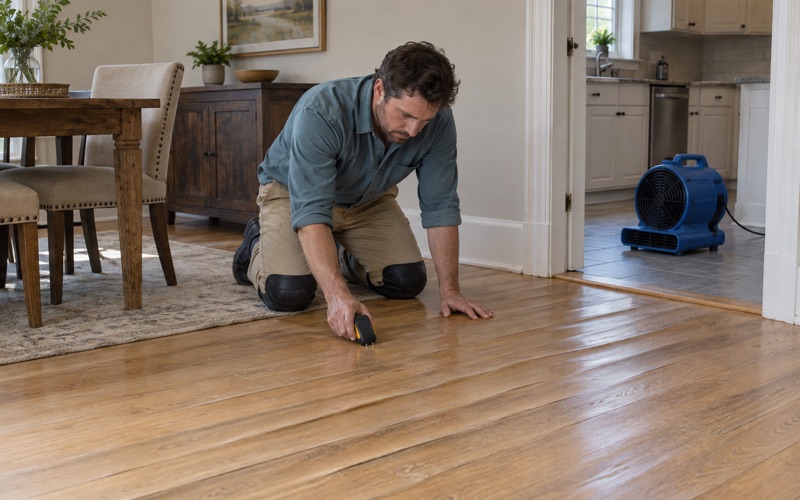
A moisture meter settles the water question. We compare readings in the affected rooms with an unaffected part of the house, let boards return toward their equilibrium moisture content, and only then decide whether a cupped floor will flatten on its own or needs boards replaced.
Seismic Retrofits and the Floor Above
ZIP code 91024 was on the 2025 Earthquake Brace + Bolt list for Southern California, and the current year’s list is worth checking. Foundation bolting and cripple wall bracing are done from the crawl space, which makes that work a natural time to look at joists, posts and subfloor too.
When a retrofit and a refinish are both planned, we prefer the structural work first. Work in the framing below can surface as new squeaks or popping above, and finishing afterward means those are dealt with before the final coats go down rather than after.
- 20+ Years in Wood Flooring
- Free Written Estimates
- Room-by-Room Schedules