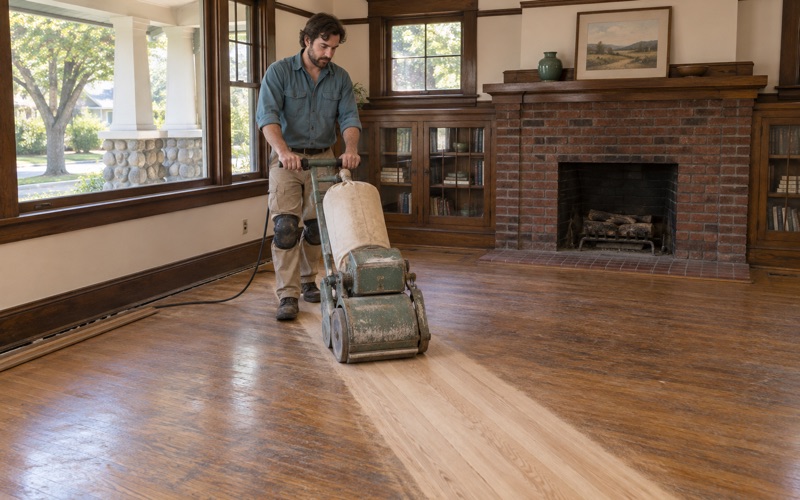
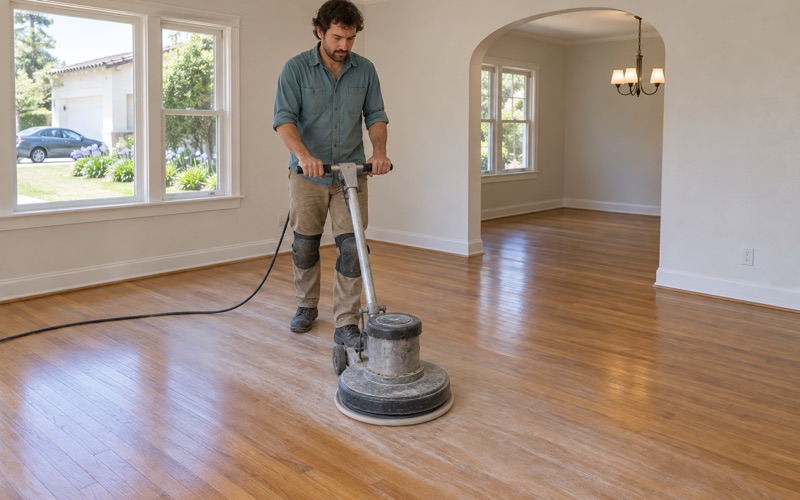
Alhambra Wood Flooring has handled wood-flooring in San Marino for more than 20 years, and the work here is almost always the same kind of job: restoring the floors of a single-family house its owner lives in. We sand and refinish original oak, replace damaged boards with matching stock, and rebuild worn stairs, usually across many rooms at once rather than a single hallway.
That shape of work changes how we plan. A whole-house refinish means furniture, rugs and daily routines move in stages, so we start with a walkthrough that records every room’s species, direction of lay, finish condition and any hollow spots, squeaks or cupping. From that record we write the sequence before a sander is unloaded.
We also confirm the build year first, look for termite evidence before replacing anything, and measure what an engineered floor can take before promising a sanding. The sections below explain why those checks matter in this city, what the local preservation rules do and do not address, and how we keep a household running while its floors are out of service.
Floors in a City of Houses Built Before 1950
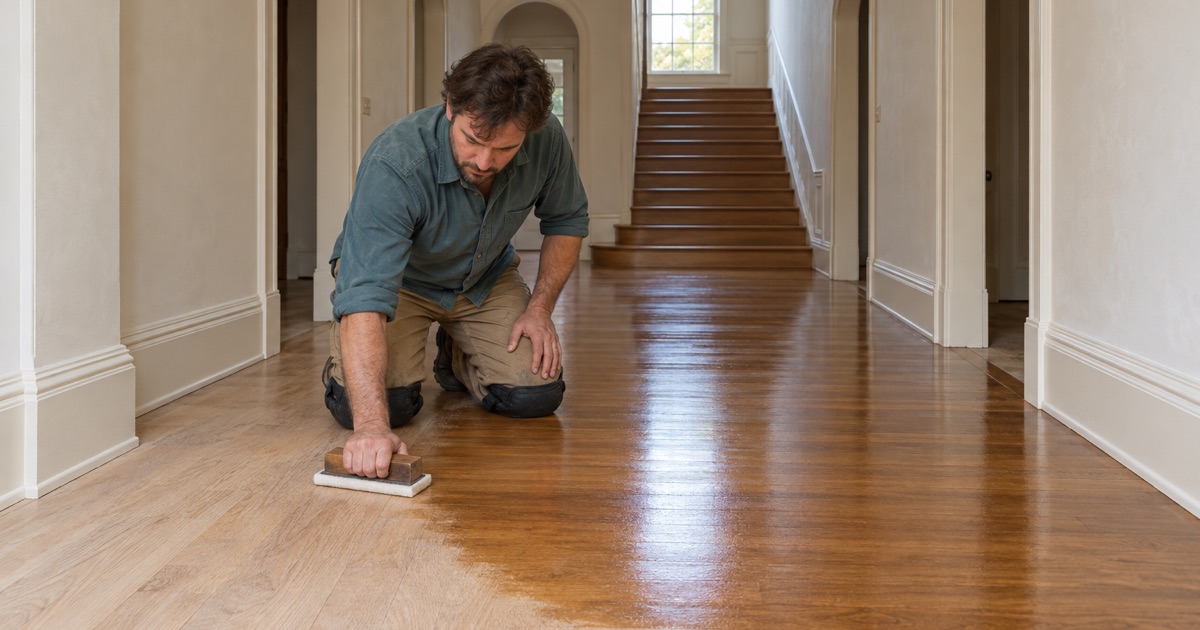
What the census says about San Marino’s housing
San Marino’s housing is unusually uniform. The Census Bureau’s 2024 five-year American Community Survey counts 4,439 housing units, and 98.6 percent of them are one-unit detached houses. There are zero units in buildings of five or more. Of the 3,910 occupied homes, 82.8 percent are lived in by their owners, which is why nearly every call we take comes from the person who will live with the result.
The small rental share looks much like the owner market. Of renter households, 96.7 percent rent a detached house, so even a tenant-occupied job here is usually a full house with its own staircase and entry rather than a unit in a larger building.
Age is the other defining number. The same survey places 40.8 percent of units in 1939 or earlier and another 28.2 percent in the 1940s, so 69.0 percent of the city’s homes were standing before 1950. Only 3.2 percent were built in 2000 or later. In practical terms, most floors we see here have been sanded before, sometimes several times, by people we will never meet.
What that age means for the boards
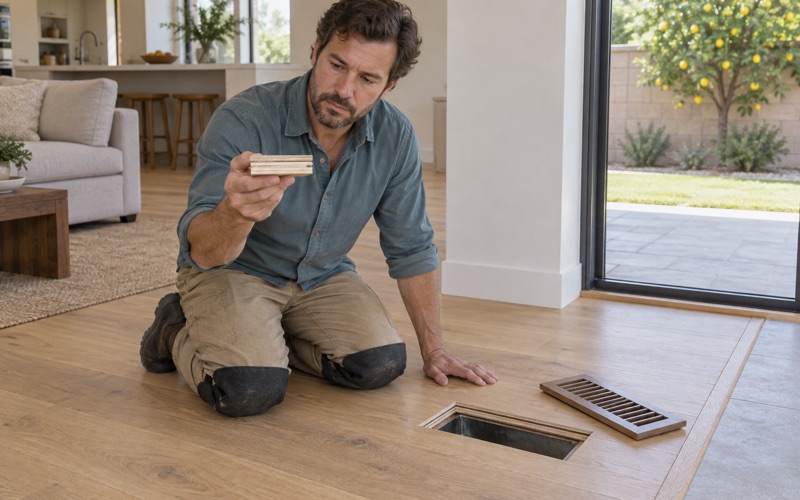
Every full sanding removes wood, and a floor laid in the 1920s or 1930s may have had three or four of them. Before we quote a refinish, we pull a floor register or check a threshold edge to see how much wood remains above the tongue and groove. Where boards are thin, exposed nail heads, splintered edges and sand-through near doorways tell us to use a lighter abrasive grit sequence or a screen and recoat.
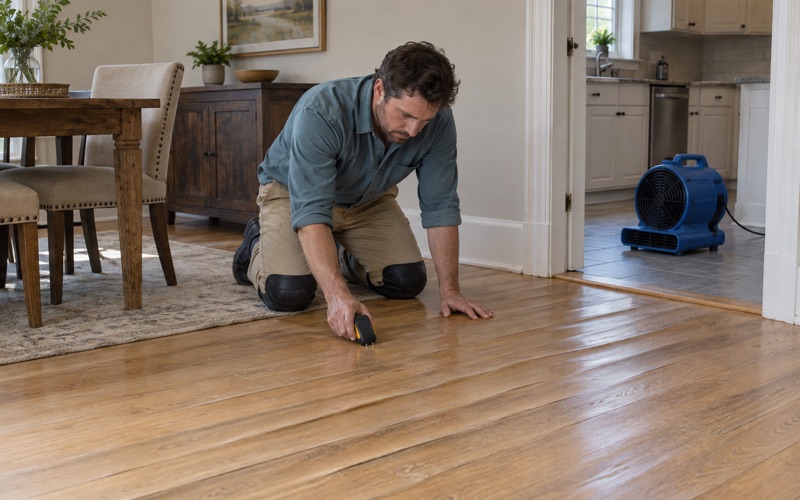
Older floors also carry decades of seasonal movement. Seasonal gapping between boards in drier months, crowning left behind by an old leak, and compression set along the wettest wall are common readings. We take moisture meter readings in several rooms so a gap that opens and closes with the seasons is not filled with a product that will crack out by the following year.
Build year and older finish layers
Because nearly every house here predates 1978, we confirm the build year before any sanding is scheduled. Paint on baseboards, shoe molding and stair stringers, along with older finish layers, is handled under the federal EPA Renovation, Repair and Painting Rule for pre-1978 housing. That affects dust containment, cleanup and where the edger works, so it belongs in the plan rather than being discovered on day one.
In practice, we treat painted trim as if it contains lead unless the owner has test results showing otherwise, keep sanding dust inside plastic barriers, and clean with HEPA vacuums before the next coat. It also shapes our advice on shoe molding and quarter round, since pulling painted trim disturbs it, so we often protect that trim in place instead.
Looking for wood-flooring closer to Rosemead? See Wood-Flooring Services in Rosemead.
Refinishing Across a Large Single-Family House
Sequencing the rooms
A whole-house job is really several smaller jobs joined at the thresholds. We group rooms so the owner always has a path to the kitchen, a bathroom and a bedroom, and we plan where each section will meet the next. A reducer or T-molding at a doorway is sometimes the right answer; a continuous run sanded in one pass through connected rooms usually looks better.
Each household gets a written room-by-room schedule listing when a room is sanded, when each coat goes down, and when furniture, rugs and pets can return. Waterborne polyurethane can usually take light foot traffic sooner than oil-modified polyurethane, but full cure time runs longer than most people expect, and rugs are the last thing back on the floor.
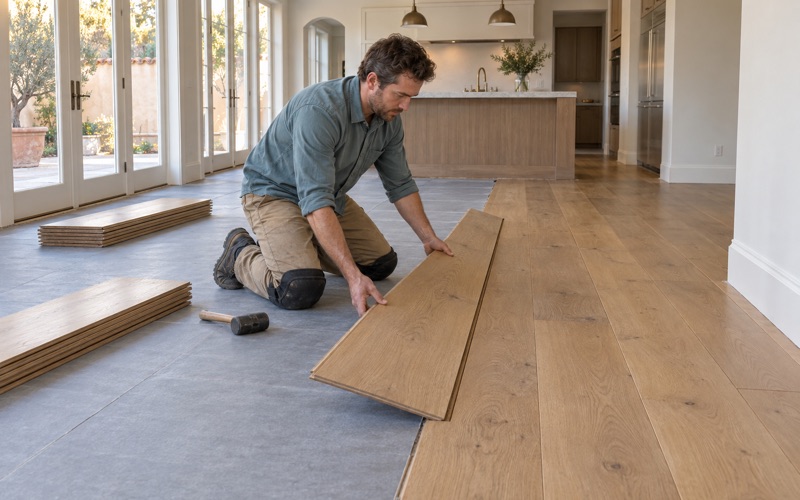
Not every room is original. A kitchen or family room added later may have engineered hardwood, and we measure its wear layer thickness before promising a sanding. A thin veneer can take a screen and recoat but not a full sand, so an addition sometimes gets a different treatment from the older rooms beside it while still being matched in color and sheen.
Stairs priced as their own work
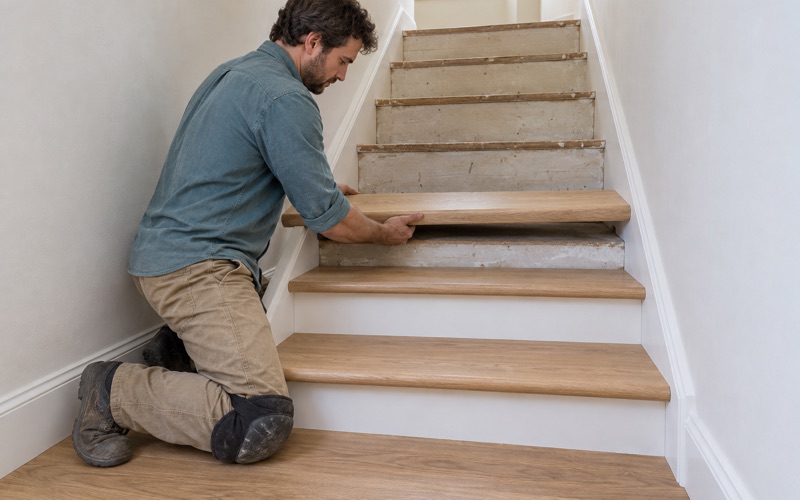
Many older two-story houses have a main staircase that sees more wear than any room. We quote stairs by the tread, riser and stair nosing instead of folding them into a square-foot price, because sanding a tread by hand, matching a nosing profile or fitting a retrofit tread takes a different kind of time than an open floor. A landing tread that meets the upstairs hallway is planned with the hallway finish.
Where treads are cracked, cupped or worn through at the center, we discuss replacement against refinishing with the owner. Original treads with good thickness can usually be sanded; badly split ones are better replaced with matching species so the whole run ages together.
Finishes legal in the South Coast air district
San Marino sits within the South Coast Air Quality Management District, and its wood coatings limit under SCAQMD Rule 1113 is 275 grams per liter. We select sealers, stains and topcoats from products that meet that limit rather than from a national catalog. That narrows the menu slightly but still includes waterborne polyurethane, compliant oil-modified options and hardwax oil, in sheen levels from matte to semi-gloss.
The choice depends on the house. A formal living room with red oak and heavy furniture may suit a satin polyurethane, while a family room with dogs may do better with a finish that can be spot-repaired. We apply a sample on a hidden board so the owner sees color and sheen on their own wood before committing a whole floor to it.
Period Revival Interiors and Matching Original Boards
Reading the original floor
San Marino’s historic resources survey, finalized in October 2020, describes an almost exclusively residential city of detached single-family houses, with no areas zoned for multi-family residential use. It found Period Revival styles dominating the architecture, with Ranch and Minimal Traditional houses in neighborhoods built before and after World War II. Houses of those styles and decades were often finished with narrow strip oak, and some formal rooms carry a border or a herringbone field.
Before any board is cut, we identify the species, the board width, whether it is plainsawn, rift sawn or quartersawn, and whether the ends are end-matched. A replacement board that is a quarter inch wider or cut from a different grain pattern will read as a patch from across the room, even after stain.
Board replacement and weave-in repairs
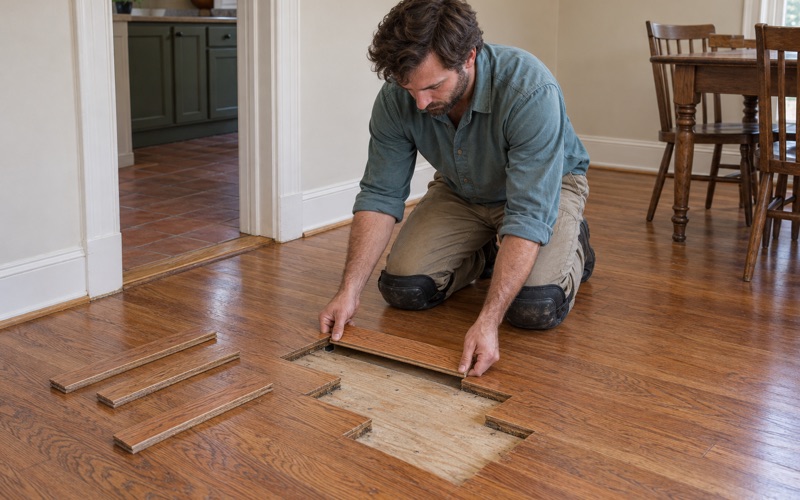
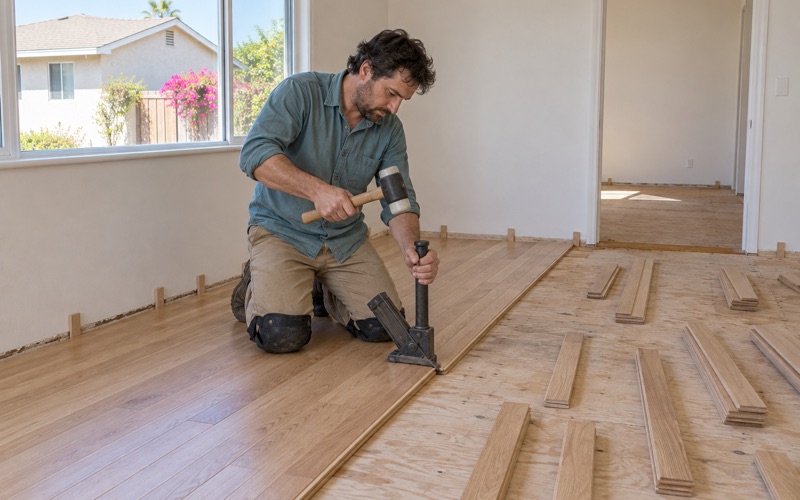
When a section is damaged by a pet urine stain, a black water stain from a plant pot, or an old radiator line, we remove the affected boards and weave new ones in at staggered joints. A straight cut across a run of boards leaves a visible seam; a weave-in repair spreads the joints the way the original installer did.
Where we can, we source reclaimed or salvaged boards from a closet or under a built-in cabinet so the new wood carries the same age and color. When no original stock is available, we match species and cut, then blend the repair during the full sanding so it takes finish at the same rate as its neighbors.
Termite evidence before any repair
Small round kick-out holes and piles of pellet-shaped termite frass near a baseboard or window sill are signs of drywood termites. We identify that evidence, or rule it out, before replacing any board, so a new board is not installed over an active colony. If the evidence is real, the owner can arrange a Wood Destroying Pests and Organisms Inspection Report and treatment before our repair goes in.
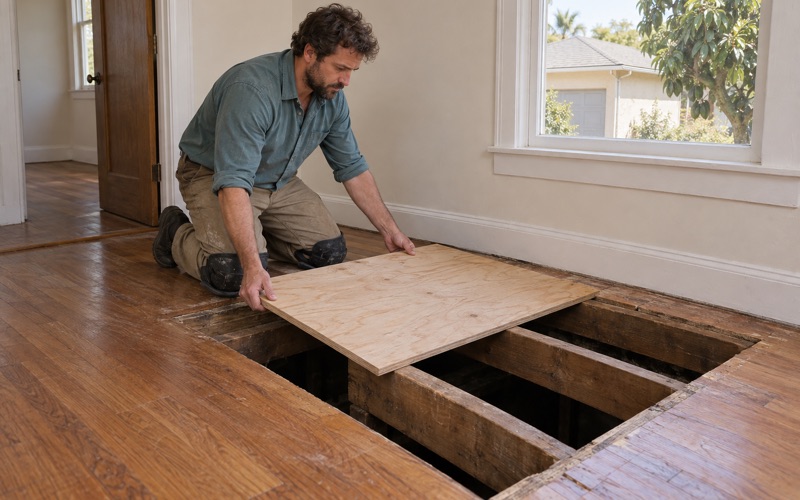
We also check for bouncy or sagging sections. Where a house sits on a raised floor with a crawl space, we look from underneath before quoting, because a soft spot can come from a floor joist, pier post or board subfloor problem that sanding would only hide.
Landmark Rules, the Mills Act, and Living in the House During Work
What the preservation ordinance covers
San Marino adopted its Historic Preservation Ordinance, Municipal Code Chapter 23.18, in 2018, with the Planning Commission acting as the preservation commission. The ordinance requires a Certificate of Appropriateness before anyone alters a designated historic landmark. The city’s survey lists nine formally designated landmarks, including El Molino Viejo and the Edwin Hubble House, so most owners we work with are not in that category.
If you do own a designated property, or one under design review for another project, we suggest confirming directly with the City of San Marino Community Development Department before work starts. We will not guess at how those rules apply to interior flooring, and we would rather the owner hear it from the Building Division at 2200 Huntington Drive than from us.
The Mills Act is about the exterior
Owners of designated landmarks sometimes ask whether a Mills Act contract helps with floor costs. The city’s program guidance states that property tax savings are meant for the exterior rehabilitation and maintenance of the historic property. Interior refinishing is a separate budget line, and we price it that way so there is no confusion when the contract paperwork is reviewed.
That does not make interior work unimportant in a landmark house. It means the floor plan is decided on its own merits: what the boards can take, what finish suits the rooms, and how the work fits the household’s calendar. We keep our scope and invoices limited to the floors so they are easy to separate from any exterior project.
Keeping an occupied home running
Because 82.8 percent of households here own and live in their houses, most jobs happen with the family still at home. We set up dust containment at doorways, run dustless sanding with vacuum-connected machines where the floor allows it, and seal returns so fine dust does not travel through the HVAC system. Odor from waterborne finishes is mild, but ventilation is still part of the daily plan.
We confirm access, parking for the equipment trailer and where machines will be staged each morning. At the end of each day, the owner knows which rooms are open, which are curing, and what happens next. When the last coat has cured and the furniture pads are down, we walk the whole house again with the original room-by-room record in hand.
- 20+ Years in Wood Flooring
- Free Written Estimates
- Room-by-Room Schedules