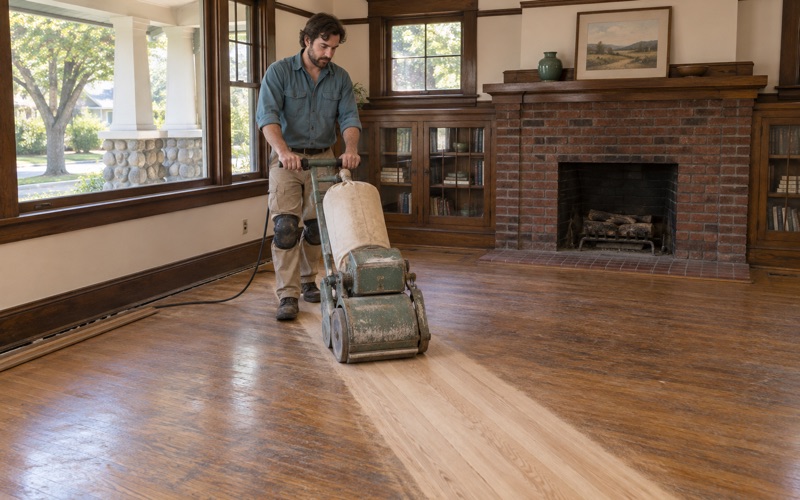
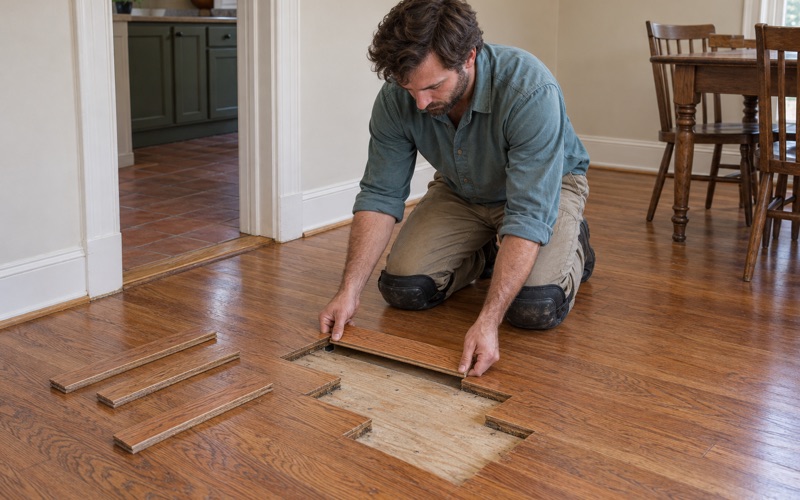
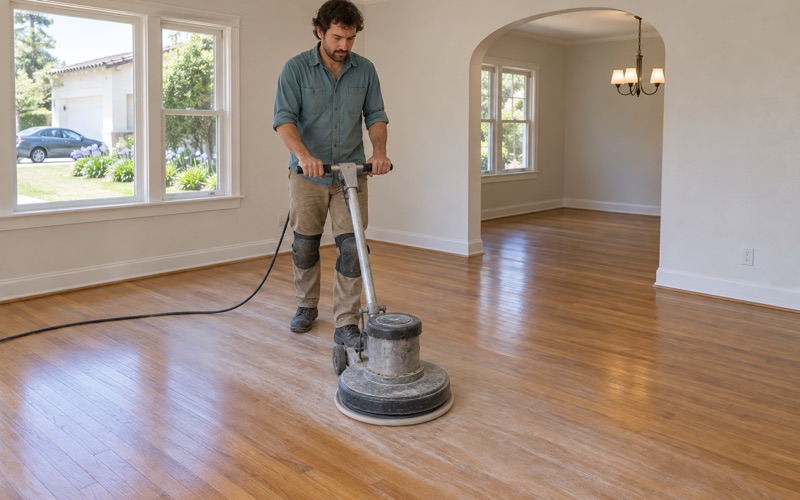
Alhambra Wood Flooring brings more than 20 years of wood-flooring work to Palos Verdes Estates, sanding, repairing and installing hardwood for households that tend to stay put. Most of what we see is solid or engineered hardwood that has been lived on for years, often refinished before, and now showing worn-through finish in traffic lanes, gray stains near doors or seasonal gapping that opens and closes through the year.
Our work starts with what the floor is made of and how much of it is left. On engineered boards we measure the wear layer before promising a full sand, because a thin veneer can take a screen and recoat but not another trip under a drum sander. On solid hardwood we look for past sand-through, overwood at board edges and old drum marks that an earlier job left behind.
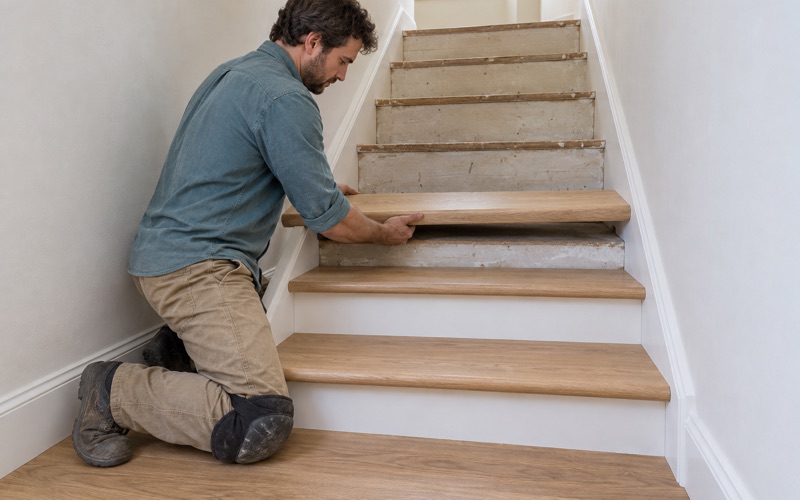
From there the quote is written in plain parts: the rooms, the stairs priced by tread, riser and nosing, the finish system and the days each room stays off limits. The sections below cover what shapes that quote in this city, from the age of the houses to the private review that governs how they look from the street.
Wood Floors in a City of Long-Term Owners
Nearly nine in ten homes are owner-occupied
The American Community Survey 2024 five-year estimates count 4,946 occupied homes in Palos Verdes Estates, and 4,436 of them, 89.7 percent, are occupied by their owners. That share changes the kind of floor work people ask for. An owner who expects to live on a floor for another decade weighs the finish, the stain color and the repair method differently than someone preparing a unit for the next tenant.
In practice that means fewer quick cosmetic passes and more questions about longevity. Owners want to know whether a board replacement will read as a patch in five years, whether a weave-in repair will match once the whole room is recoated, and whether a floor sanded several times already has another full sand left in it. We answer those before a price is set.
Detached houses and whole-level projects
Of those owner households, 4,318 live in detached houses, which is 97.3 percent of all owners in the city. Attached and multi-unit homes make up a small remainder. For floor work, that puts the decisions with the household itself, and the questions are about the house: its subfloor, its stairs, the transitions between wood and tile, and how the rooms connect.
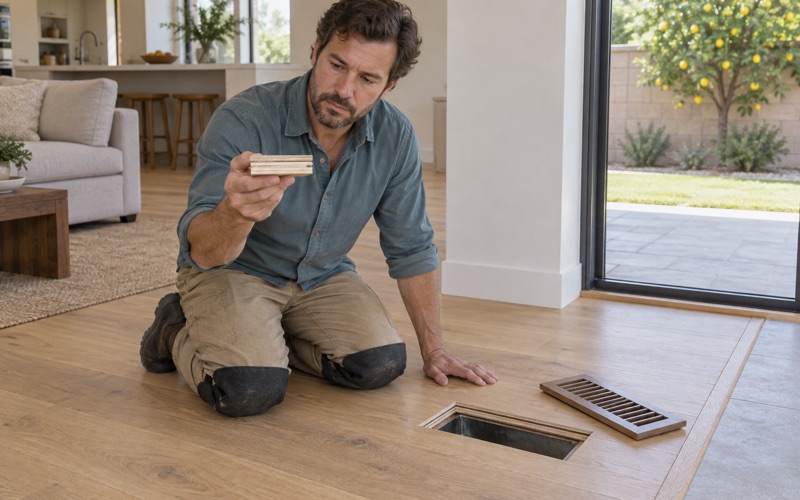
It also means a project can run through a whole level at once. When hallways, living rooms and bedrooms share one continuous floor, sanding them together keeps the color even across doorways and avoids a visible line where one phase stopped. We plan reducers, T-molding and shoe molding where the wood meets other surfaces, so the finished floor reads as one surface rather than several.
Floors that have been refinished before
A house that has stayed with one or two owners for decades has often had its floors refinished at least once, sometimes by several different crews. We read what earlier work left: chatter marks, edger swirl along the baseboards, finish peeling where an incompatible coat went over an old one, or white haze trapped between layers. Each of those changes how aggressive the first step of the abrasive grit sequence needs to be.
Looking for wood-flooring closer to South Pasadena? See Wood-Flooring in South Pasadena.
Refinishing Floors in 1950s and 1960s Houses
The two decades that built most of the city
The same census estimates show 1,465 homes built from 1950 to 1959 and 1,329 built from 1960 to 1969. Together those two decades account for 52.0 percent of the housing in Palos Verdes Estates, while only 4.5 percent of homes predate 1940. The floor we are usually called to here belongs to a mid-century custom or tract house rather than to the city’s earliest years.
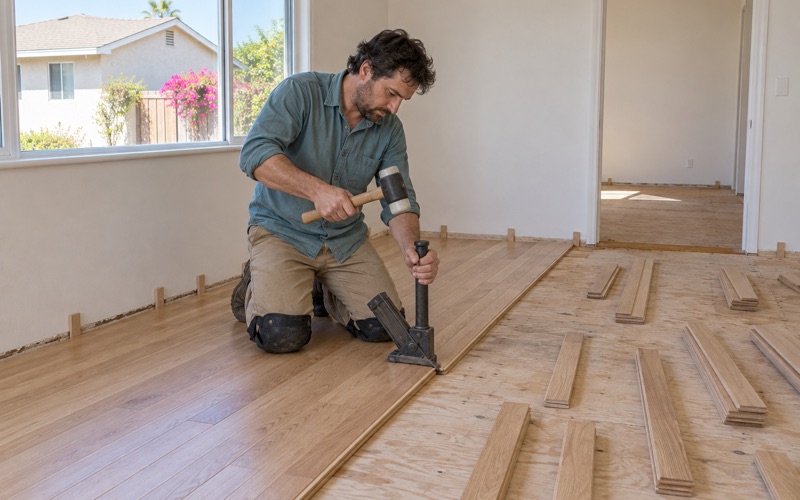
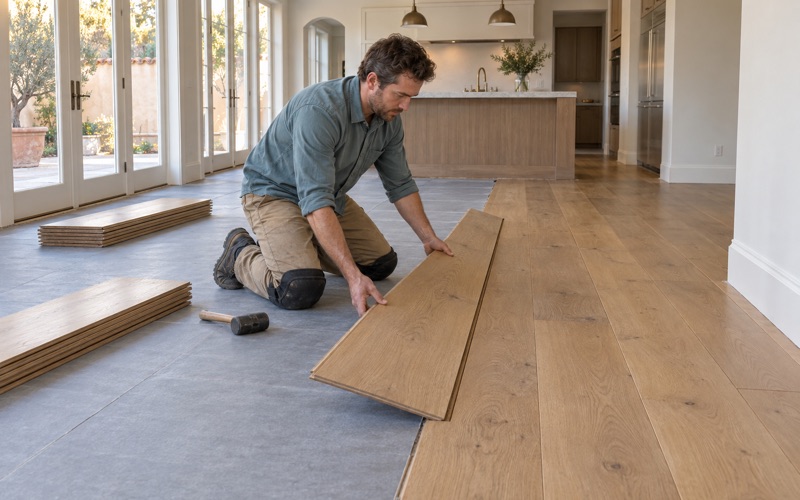
Mid-century floors are often oak strip laid tongue and groove, though additions and remodels over the years can bring in wide plank, engineered boards or luxury vinyl plank in a kitchen. We identify the species and construction room by room, because a refinish that treats a plainsawn oak hallway and an engineered family room the same way will not match when it is done.
Build year before the sander comes out
We confirm the build year before any sanding goes on the calendar. Homes built before 1978 can carry lead in old paint and finish layers, and those layers are handled under the EPA Renovation, Repair and Painting Rule. With so many of this city’s houses dating from the 1950s and 1960s, that check is rarely a formality here.
Knowing the year also hints at what might sit under the current surface. A mid-century floor may have spent years under carpet, sheet goods or a later layer of wood, and the adhesive or fasteners left behind shape the prep. We note what we find and set the dust containment and cleanup plan before the first pass, not after it.
Sags, squeaks and soft spots
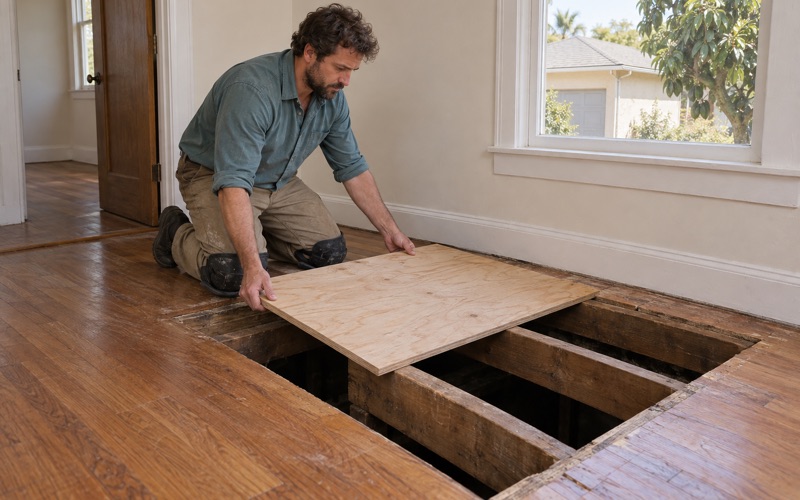
A sagging floor, a bouncy floor or a soft spot near a doorway is not something a sander fixes. After sixty or seventy years, squeaks, popping and hollow spots can trace back to loose fasteners, a tired subfloor or the framing below. Where a house has access underneath, we look there before quoting, because sanding over a structural problem only hides it for a while.
When the cause is in the framing, the repair might be a sister joist, added blocking or refastening a board subfloor or diagonal sheathing, and that work comes before any refinishing. When the floor is sound and the noise is only a loose board, we secure it from above. Either way, the written scope says which one we found and why.
Interior Floors in a Deed-Restricted, Planned City
What the Art Jury reviews
Palos Verdes Estates is governed by Basic Protective Restrictions recorded in 1923, and the Palos Verdes Homes Association Art Jury enforces them. According to the Homes Association’s own FAQ, the Art Jury reviews plans that pertain to the external aesthetic appearance of structures and properties, covering new construction, remodels and maintenance such as repainting, re-roofing and replacing windows and doors.
That FAQ does not address interior-only work, and we do not guess at an answer on anyone’s behalf. If a floor project connects to changes that show from outside, such as new doors to a patio, we suggest the owner raise it with the Homes Association directly. For the floor itself, we write the scope clearly so that conversation is easy to have.
Questions that belong with the city
Building questions here go to the City of Palos Verdes Estates Building and Safety, part of the Planning and Building Department at 340 Palos Verdes Drive West. The city also operates under a Local Coastal Program certified in 1991. We do not give owners a permit answer for floor work under either system; when a project reaches beyond the floor, we point them to the city.
Malaga Cove, Lunada Bay, Valmonte and Montemalaga
The city was developed in 1923 from part of the former Rancho de los Palos Verdes, and it incorporated on December 20, 1939. Its planners were Charles Cheney and Frederick Law Olmsted Jr. Malaga Cove Plaza, designed by Myron Hunt, was listed on the National Register of Historic Places in 1995.
For floor work, the useful point is that houses across Malaga Cove, Lunada Bay, Valmonte and Montemalaga were built in different years and remodeled on different schedules. Two homes a few streets apart can hold a mid-century oak strip floor and a much newer engineered plank, and they need different plans. We treat each address on its own record rather than assuming a neighborhood pattern.
Choosing a Finish for a Home You Plan to Keep
Coatings that meet the South Coast limit
The South Coast Air Quality Management District regulates air quality across large areas of Los Angeles County, and its Rule 1113 caps wood coatings at 275 grams per liter. We choose sealers, stains and topcoats from products that meet that limit rather than from a national catalog, so the finish going down is one that can legally be applied in the district.
Within that limit there is still real choice. Waterborne polyurethane dries clear and allows a shorter recoat window, oil-modified polyurethane ambers over time and suits some oak floors, and hardwax oil gives a lower-luster look that is maintained differently. We walk through each with the long run in mind, because the finish chosen now is the one the household will live with.
Sheen, stain and a floor meant to last
Sheen level matters more on a floor someone plans to keep. Satin and matte hide everyday scratches and dust better than gloss, and a lighter stain on white oak shows less wear in busy lanes than a dark one. We apply samples in the actual room, under its own light, before a stain is chosen, since a color that looks right elsewhere can read very differently at home.
We also plan for upkeep. A well-kept finish can often be refreshed with a buff and coat, or a screen and recoat, well before it needs another full sand, which preserves the wear layer on engineered boards and the remaining wood on solid ones. We explain when that lighter service makes sense so a future visit costs less than this one.
A written schedule for the household
Refinishing a whole level means planning around furniture, rugs, pets and daily routine. We give each household a written room-by-room schedule showing when a space can take foot traffic in socks, when furniture can return and when rugs can go back down after the finish reaches its cure time. Owners living in the house during the work can then decide which rooms to give up first.
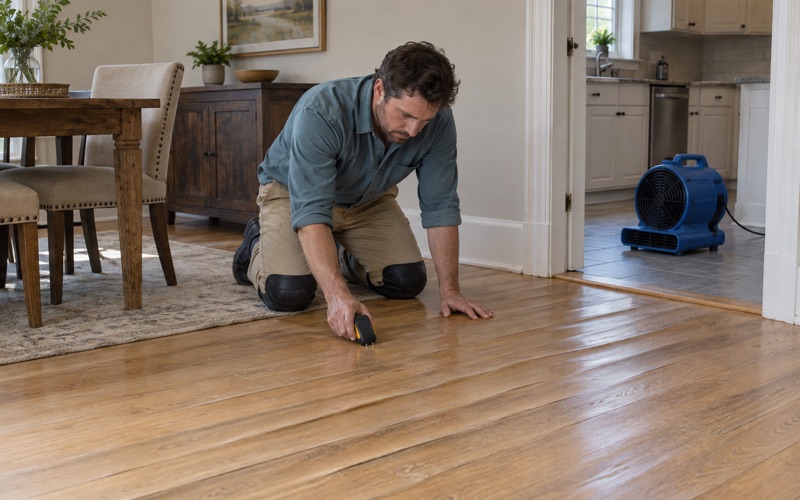
If moisture meter readings, a damaged board or a worn stair nosing change the plan partway through, the schedule is updated in writing rather than by word of mouth. That keeps a longer project predictable for a family staying in its own home while the floors are done.
- 20+ Years in Wood Flooring
- Free Written Estimates
- Room-by-Room Schedules