Alhambra Wood Flooring provides wood-flooring in North El Monte with more than 20 years of experience behind the work, from sanding and refinishing to board repair, stair rebuilding and new installation. Our estimates start with questions about the house rather than a square-foot number, because the right answer for a floor depends on what sits under it, what finish is already on it and how long it has been down.
The floors we are asked to look at tend to share a short list of complaints: a worn-through finish in the hallway, gray stains near an exterior door, squeaks along a joist line, or boards that cup in one season and gap in the next. Each has a different cause. Treating them all with a quick sand and recoat is how a problem gets hidden instead of fixed.
So we sort the work before we price it. Some floors need only a screen and recoat, some need a full sand to bare wood, and some need board replacement or subfloor attention first. You receive a written scope that names the approach for each room, the finish we plan to use and the day each space can be used again.
A Neighborhood Built in One Decade
What the Census Shows
North El Monte is a census-designated place in the San Gabriel Valley, and its housing record is unusually concentrated. American Community Survey 2024 five-year estimates count 1,297 housing units, and 620 of them, 47.8 percent, were built between 1950 and 1959. Widen the window to 1940 through 1969 and the share reaches 75.3 percent.
The newer end of the record is thin. Only 55 homes, 4.2 percent, date from 2000 or later, and the survey reports none built since 2010. For a floor contractor, that means a typical job here is not a recent build with a factory finish but a house that has already been through decades of refinishing, repair and remodeling.
Mostly Detached Houses
The housing type is as consistent as the era. Of those 1,297 units, 1,166 are one-unit detached houses, or 89.9 percent, and among owner households 95.4 percent live in a detached home. Attached units and small apartment buildings exist, but they make up a minor share of the stock.
That profile shapes the calls we expect from North El Monte: whole-house refinishing, bedrooms joined by long hallways, and additions where an older floor meets a newer one. Association rules for hard flooring rarely come into play, though we still check them on the attached units and small buildings where they apply before any material is ordered.
Why One Era Matters for a Floor
When much of a neighborhood went up in the same decade, many homes share materials and building habits from that time. That is useful, but it is a starting point rather than a conclusion. Additions, earlier remodels and previous flooring jobs make each house its own case, so we inspect instead of assuming.
In practice, a 1950s house may hold an original strip floor in the bedrooms, a replaced floor in the kitchen and a family room added later over a different subfloor. We map those transitions room by room, so a refinish plan does not treat three floors as one, and so reducers and thresholds line up when the work is done.
Looking for wood-flooring closer to Sierra Madre? See Sierra Madre Wood-Flooring.
Wood Floors in North El Monte’s 1950s Houses
Oak Under the Carpet
Houses from the 1940s through the 1960s often received solid hardwood, commonly red oak or white oak strip laid tongue and groove, and later owners frequently covered it with carpet, vinyl or laminate. When that covering comes up, we find everything from a floor that needs only sanding to one marked by staple holes, tack strip damage, pet urine stains and old adhesive.
Before we promise a result, we check how much wood remains above the tongue. A strip floor that has been sanded several times can still take another full sand if enough material is left. One worn close to the tongue may need a lighter approach, or board replacement in the thinnest areas.
Squeaks, Bounce and Sloping Floors
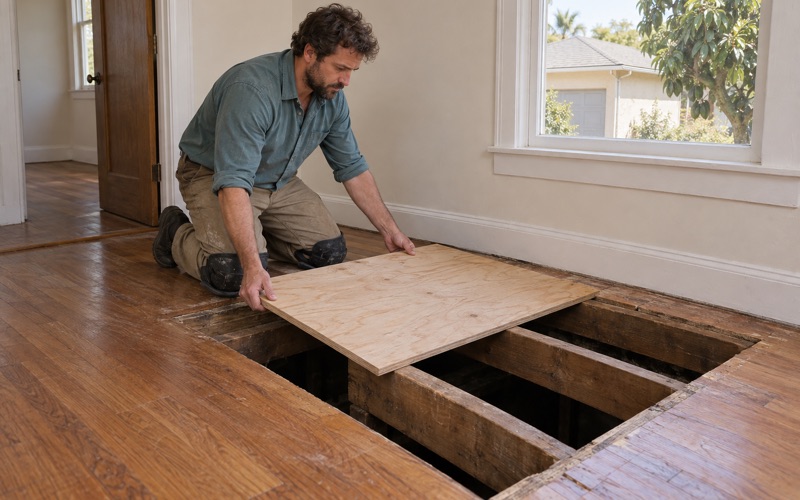
Seventy years of movement shows up as squeaks, popping, hollow spots and, in some houses, a bouncy or sagging floor. Where a house has a raised floor over a crawl space, we look from underneath before we quote. A soft spot or a sloping floor there is often a floor joist, pier post or subfloor issue that sanding cannot correct.
Fixes from below can include a sister joist, added blocking, a reset post or refastened board subfloor. Doing that before the finish work keeps a new coat from cracking along a moving seam. If a house sits on a slab-on-grade instead, the questions turn to moisture and flatness, and we test before recommending a glue-down installation or a floating floor.
Termites and Old Damage
Small round kick-out holes and piles of pellet-shaped termite frass near baseboards or thresholds point to drywood termites. We identify that evidence or rule it out before any board is replaced. If a colony looks active, we recommend dealing with it first, whether through tent fumigation or a localized termite treatment chosen by a pest professional.
A Wood Destroying Pests and Organisms Inspection Report, if you already have one, shows us what was found and what was treated. Replacing boards over an untreated colony only means doing the repair twice, and signs of powderpost beetle activity get the same attention before we order material.
An Arcadia Address, a County Jurisdiction
ZIP Code 91006
North El Monte uses ZIP code 91006, an Arcadia ZIP, so a mailing address here reads Arcadia. The community is not part of Arcadia, and it is not part of El Monte either. It first appeared as a census-designated place in the 1990 census and has no city government of its own.
That mismatch matters more than it looks. Online lookups, supplier forms and even some contractors assume the mailing city is the authority in charge, then read the wrong city’s rules. We confirm the jurisdiction from the property’s location, not from the envelope.
Schools follow their own lines as well: the neighborhood is served by the El Monte City School District and the El Monte Union High School District. Each name attached to North El Monte answers a different question. Only the County answers questions about work on the house itself.
Los Angeles County as the Authority
North El Monte is unincorporated Los Angeles County. Building services for unincorporated communities come from Los Angeles County Public Works, Building and Safety, through its headquarters and district offices. Whether a particular floor project calls for any County review is a question for the County, and we raise it with you during planning rather than guess.
The County Historic Preservation Ordinance, adopted September 1, 2015, applies to unincorporated areas and County-owned land. We are not aware of a designated landmark in North El Monte, but if your home carries a County designation or a Mills Act contract, tell us early so the scope can account for it.
The Federal Lead Rule on an Older House
With most of the housing here built well before 1978, the EPA Renovation, Repair and Painting Rule is part of the planning for many jobs. Old finish layers, painted baseboards and trim can carry lead-based paint, so we confirm the build year before any sanding is scheduled and set up containment and cleanup under the federal rule.
Lead-safe practice affects the schedule as well as the method. Containment takes time to set up, cleanup is checked before a room is released, and any painted shoe molding or quarter round we remove is handled inside the same work area rather than pulled out casually on the first morning.
Refinish, Repair or Replace a 1950s Floor
Screen and Recoat or Full Sand
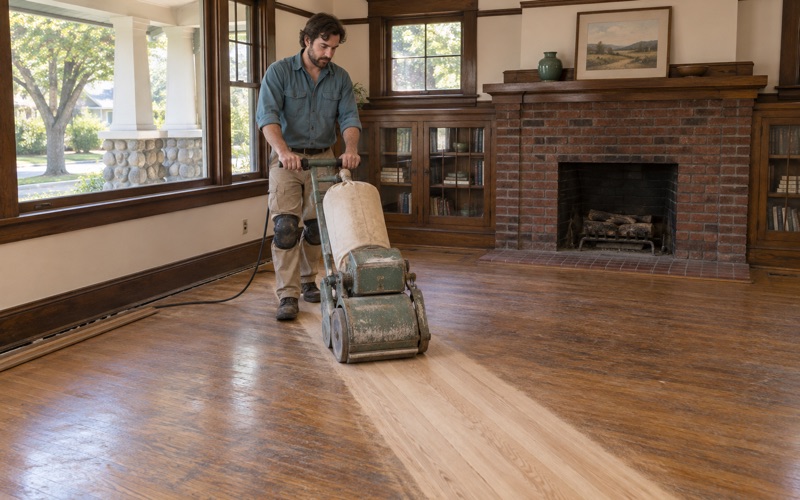
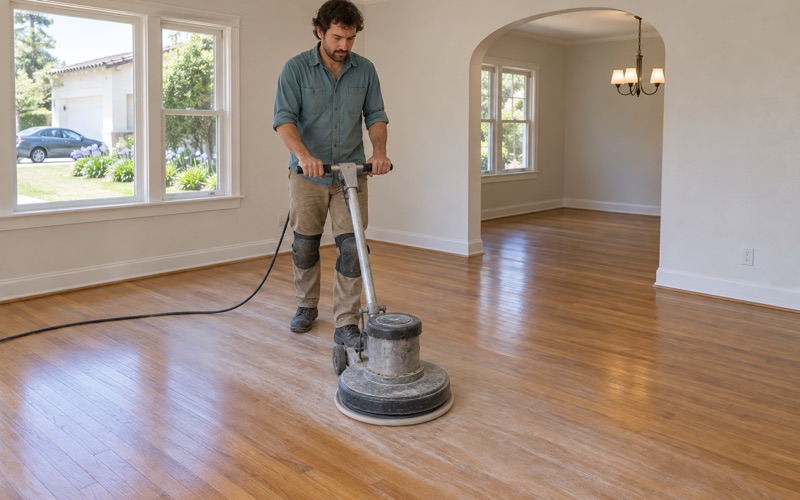
If the finish is dull and scratched but the wood is intact, a screen and recoat can restore it without removing wood. Gray stains, black water stains, deep pet urine damage and finish peeling usually call for a full sand through an abrasive grit sequence, using a drum sander, edger and orbital sander with dust containment.
On an engineered floor, we measure the wear layer first. A thin veneer can take a buff and coat but not a full sand, and promising one invites a sand-through. Finishes come from waterborne polyurethane, oil-modified polyurethane and hardwax oil products legal under the South Coast air district’s wood coatings limit of 275 grams per liter, not from a national catalog.
Gaps, Cupping and Crowning
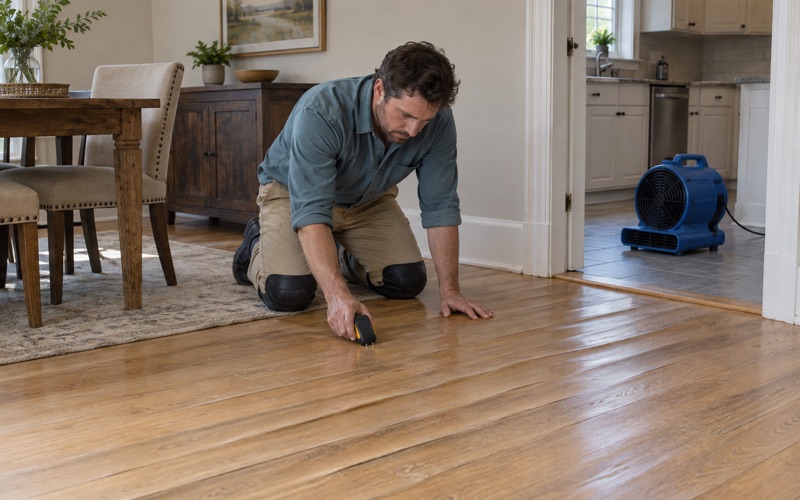
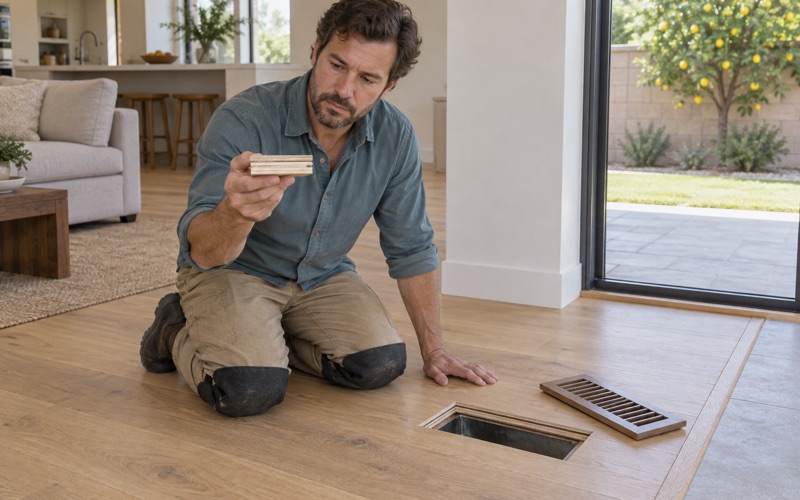
Not every gap is damage. Seasonal gapping opens in drier months and closes as relative humidity rises, and filling those gaps tightly can lead to crowning or buckling later. We read the moisture content of the boards against equilibrium moisture content before deciding whether a gap needs filler, a new board or simply time.
Cupping works the other way, with board edges rising above the centers because moisture is coming from below. Sanding a cupped floor flat before the source is found leaves boards that crown once they dry. We locate the moisture first, then schedule the sanding after readings settle.
When Replacement Makes Sense
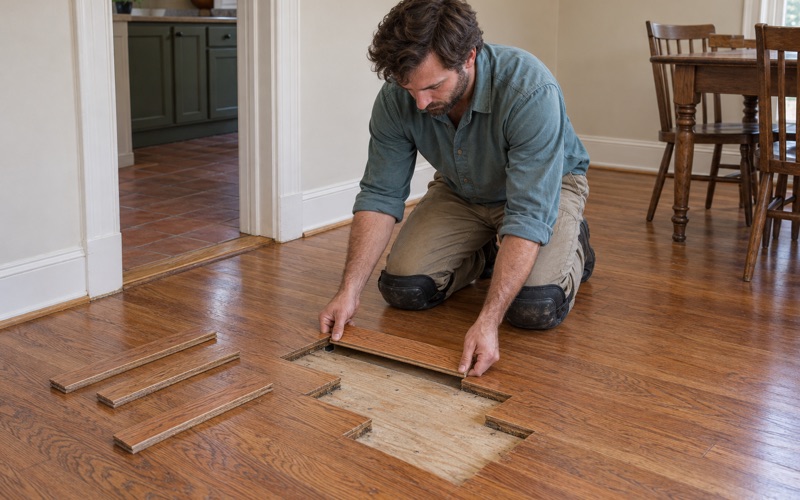
Boards that are split, rotted, termite-damaged or already sanded too thin get a weave-in repair, with new boards staggered into the old field so the patch does not read as a rectangle. We match species, width and grain, then blend stain and sheen level across the room so the repair disappears.
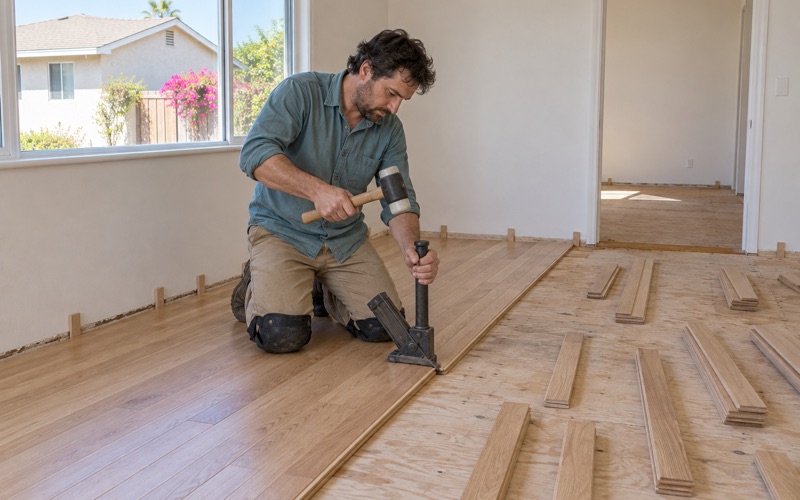
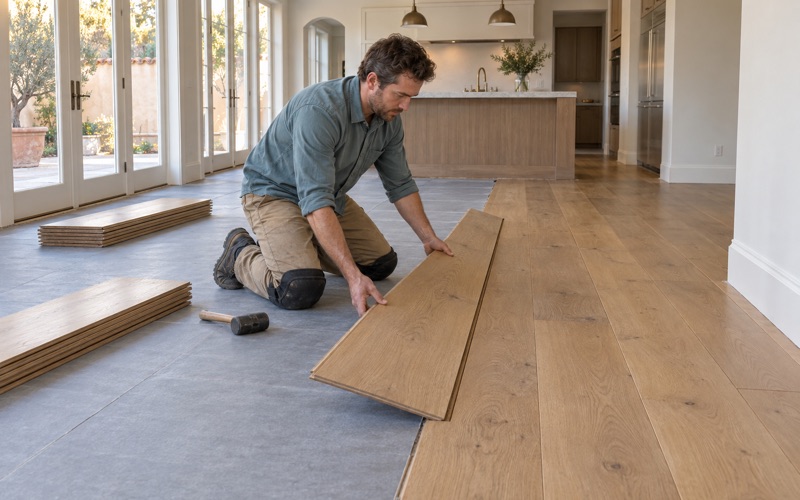
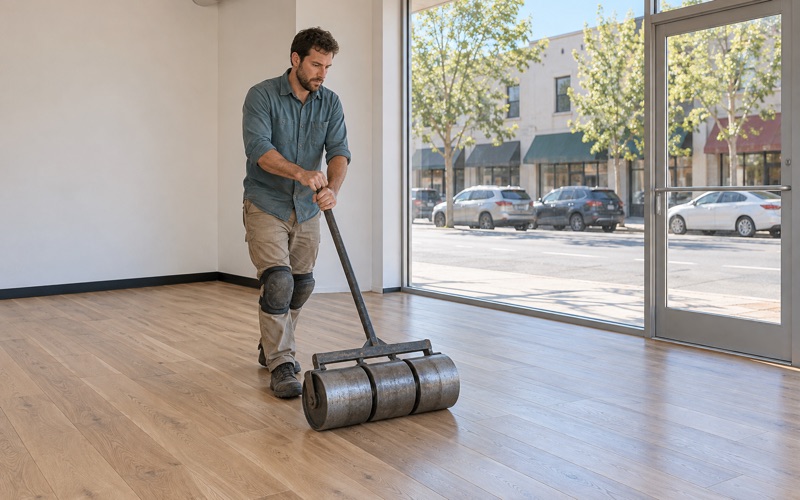
Where the old floor is past saving, we install new solid hardwood by nail-down over a sound subfloor, or engineered hardwood as a glue-down or floating floor depending on what lies underneath. Acclimation, moisture meter readings and an expansion gap at the walls all come before the first board goes down.
Planning Around the Work
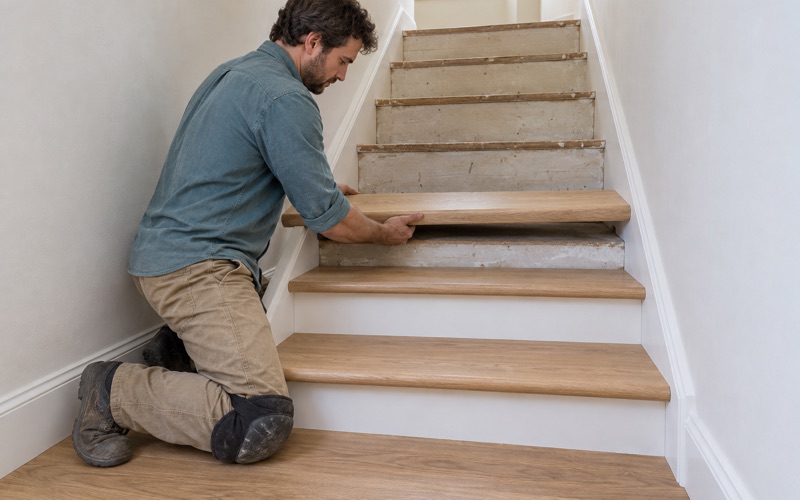
Stairs are quoted by the tread, riser and nosing, because stair work is built and priced differently from open floor. For water or smoke losses, we document conditions with photos and moisture readings an adjuster can use, and write the repair as matching board and finish rather than a patch.
Every project includes a written room-by-room schedule showing when furniture, rugs and pets can return after the cure time. If you know the year your house was built, share it when you call, and we will start the plan from there.
- 20+ Years in Wood Flooring
- Free Written Estimates
- Room-by-Room Schedules