Alhambra Wood Flooring brings more than 20 years of hands-on work to wood-flooring in Los Alamitos, from sanding and refinishing tired strip floors to board replacement, stair work and new installations. We start every estimate by learning when the house or building went up, because that date shapes how an old finish comes off and which repair is realistic.
The floors we are asked to look at have usually been through decades of use. One shows worn-through finish down the hallway and a gray stain by the back door; another carries pet urine stain, cupping near the kitchen, or squeaks that get louder each winter. Each of those has a different cause, and our quote is written around the cause rather than a flat square-foot number.
Owners, landlords and association boards plan in different ways, so the schedule is written around how the space is used. A household gets a room-by-room calendar showing when furniture, rugs and pets can come back. A rental gets dates that fit the gap between one tenancy and the next, with the floor recorded before and after.
Carrier Row and the City’s Early Postwar Floors
Streets Named for Aircraft Carriers
Los Alamitos, in Orange County, was founded in 1896 around a sugar-beet factory and incorporated in March 1960, yet very little of its housing predates the Second World War. Census estimates count just 23 units built in 1939 or earlier. The early residential stock came after the war, and Carrier Row is the neighborhood most tied to that period.
Carrier Row takes its name from its streets, which carry the names of World War II aircraft carriers. It went up in phases in 1947-48, 1950 and 1955. Across the city, 155 units date from the 1940s and 797 from the 1950s, so 21.1 percent of Los Alamitos housing was built before 1960.
Reading a Floor From the 1940s or 1950s
A floor laid seven decades ago has usually been sanded before, sometimes more than once. Before we promise a full sand, we check remaining board thickness at a register or threshold, look for old sand-through along the edges, and note where earlier refinishers left overwood, chatter marks or edger swirl that a careless pass would deepen.
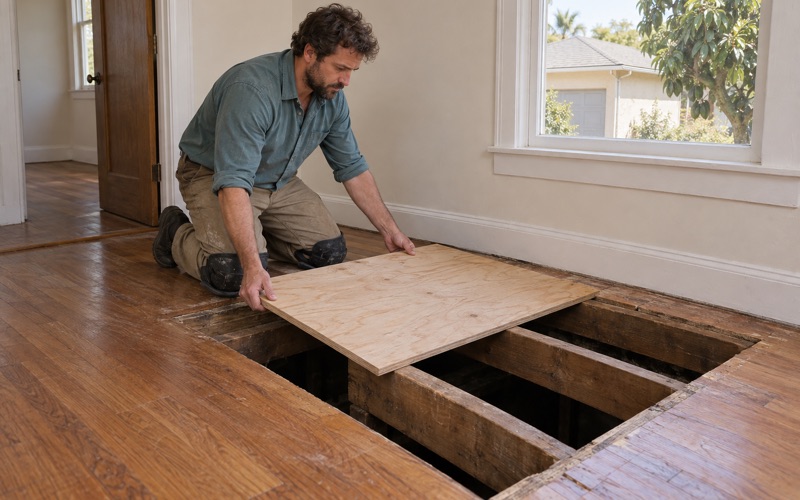
We never assume what sits under the boards in a house of this age. A soft spot, a sloping floor or a run of popping fasteners can come from the flooring cleats, the subfloor or the framing below, so we find the source first. Only then do we decide whether sanding, board replacement or structural repair should come first.
Repairs That Blend Into Old Boards
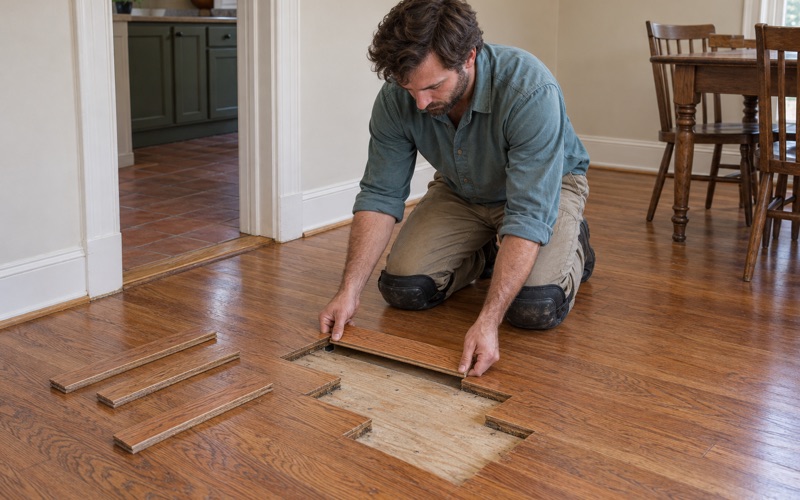
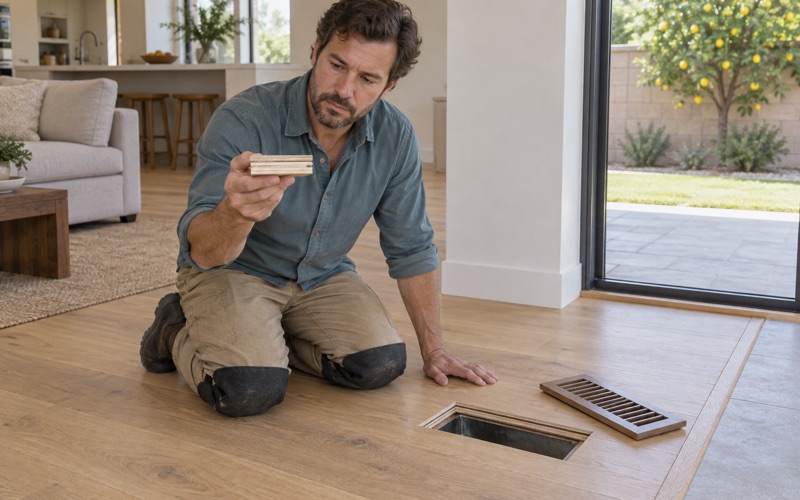
Older houses often carry the marks of past remodels: a wall that moved, a heating grille that was relocated, a doorway that was closed. Where that has left a gap or a mismatched strip, we use a weave-in repair, lacing new boards into the existing field so the joints stagger naturally instead of forming a visible square patch.
Small round holes or a pile of tiny pellets near a baseboard get identified or ruled out before any board comes out. If it is drywood termite frass from kick-out holes, the infestation needs treatment first, because a new board set down over an active colony is simply more food for it.
Looking for wood-flooring closer to El Segundo? See Wood-Flooring Services in El Segundo.
Los Alamitos’ 1960s Detached Houses
The City’s Biggest Building Decade
The 1960s produced more of Los Alamitos’ housing than any other decade: 1,302 units, or 28.2 percent of the total, according to the 2024 American Community Survey five-year estimates. Building stayed busy through the 1970s with another 981 units, and 70.5 percent of the city’s housing now predates 1980.
That timing matters to anyone planning a sanding job. Much of this stock falls inside the pre-1978 window, so we confirm the build year before a sanding date goes on the calendar. When a home qualifies, old paint and finish layers are handled under the EPA Renovation, Repair and Painting Rule, with dust containment set up before the first pass.
When Carpet Comes Up
Pulling carpet in a house from this era can reveal anything from a clean red oak floor to tack strip holes, glue residue and water marks nobody knew about. We look at what is actually there before recommending a direction, since a floor with a sound old finish and shallow wear may only need a screen and recoat.
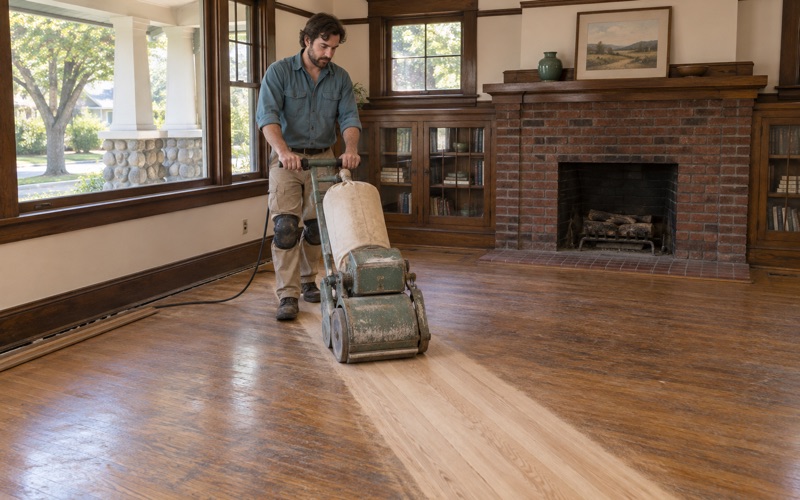
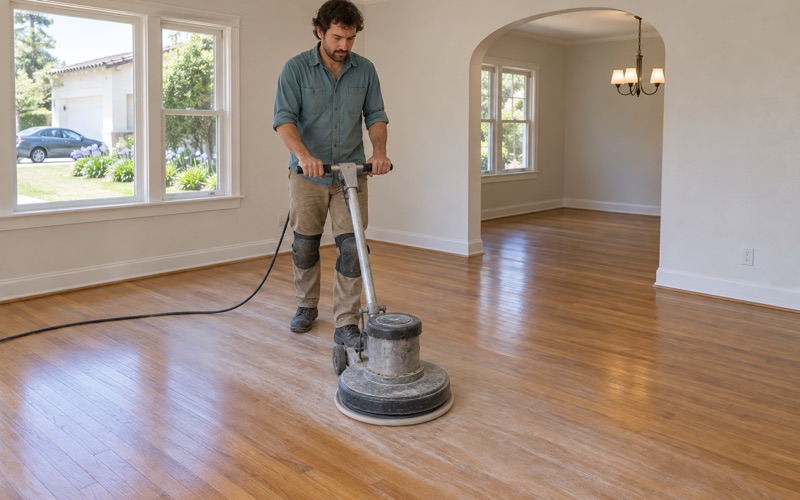
Deeper problems call for a full sand with a drum sander, edger and orbital sander, working through an abrasive grit sequence matched to the finish coming off. Black water stain usually means board replacement rather than sanding, because the discoloration runs deeper than any sander should go. Stain comes after that, if the owner wants a new color.
Engineered hardwood added during a later remodel gets a different check. We measure wear layer thickness before promising anything, since a thin veneer can take a screen and recoat but not a full sand, and sanding it anyway risks exposing the core layer.
Finishes Chosen for the South Coast Air District
All of Orange County falls under the South Coast Air Quality Management District, whose Rule 1113 sets a wood coatings VOC limit of 275 grams per liter. We choose sealers, waterborne polyurethane and oil-modified polyurethane from products that are legal to apply here, not from a national catalog that was never written with this district in mind.
Each finish carries its own cure time and recoat window, and those numbers set the written schedule. We tell the household which rooms can take socks first, when rugs can go back down, and when a dog’s nails are safe on the new sheen level.
Fourplexes and Small Apartment Buildings
A City Where Most Households Rent
Renters make up 57.6 percent of Los Alamitos households, 2,542 of 4,414 occupied units. Many of them live in modest buildings: 753 renter households are in three- or four-unit structures and 665 in buildings of five to nine units, together 55.8 percent of all renter households in the city.
For the owner of a small building, flooring is less about one showpiece room and more about keeping several units consistent. Where the owner wants a uniform look, we match species, stain color and sheen across units, so a later repair in one apartment does not stand out from the one next door.
Finish choice changes too when units turn over every year or two. A tougher finish system and a lower sheen hide daily scuffs better between tenancies, and a floor kept on a regular buff and coat cycle can often skip a full sand for years. We lay those options out with their costs so the owner can compare them against the rent calendar.
Turnovers Built Around Move-Out and Move-In
An empty unit is the easiest time to sand, and the gap between tenants is usually short. We schedule backward from the move-in date, pick a finish whose cure time fits that window, and say early if the gap is too tight for a full sand so a screen and recoat can be weighed instead.
We photograph and note the floor’s condition at move-out and again when our work is done. The owner or property manager ends up with a dated record from both sides of the tenancy, which helps when questions about a pet stain, deep scratches or a finish peeling near the entry come up later.
Attached Homes and Association Rules
One-unit attached homes make up 10.4 percent of the city’s housing units. Before we order material for a condo or townhome, we read the association’s own rules on hard flooring and underlayment, since many boards set requirements for what can be installed over a shared floor and ceiling.
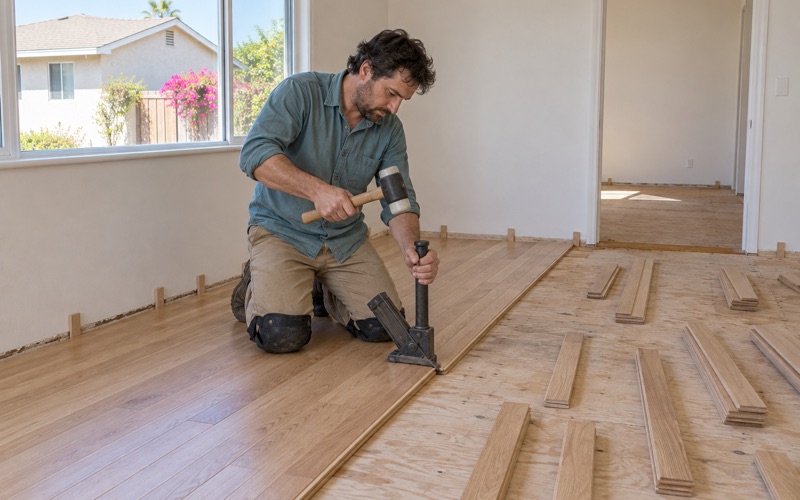
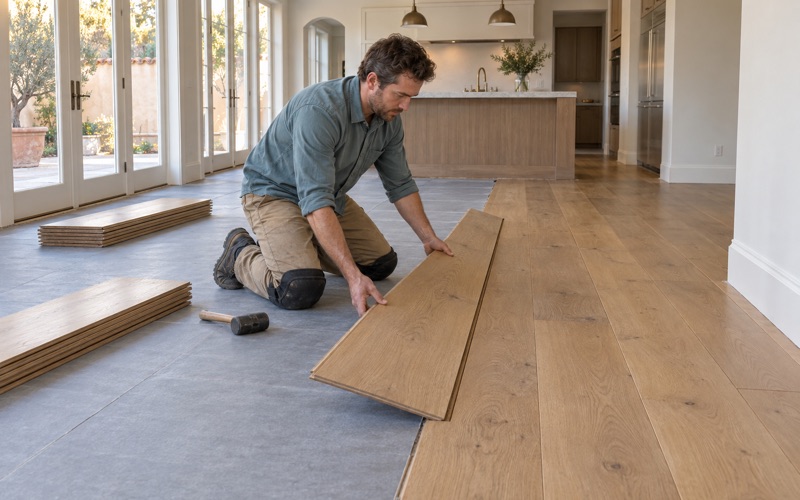
If those rules call for a particular acoustic underlayment or installation method, it goes into the price from the start. A floating floor, a glue-down installation and a nail-down installation each fit association rules differently, and we would rather settle that on paper than after the boxes arrive.
What a Los Alamitos Flooring Job Involves
The City’s Business License Requirement
The City of Los Alamitos Development Services Department handles construction permitting through its Building and Safety Division, which runs an online Building Permit Center and a walk-in counter open 7:30 a.m. to 12:30 p.m. Monday through Thursday. The division’s FAQ states that contractors working in the city are required to have a Los Alamitos Business License.
The same FAQ says a Certificate of Workers’ Compensation Insurance must be on file when a contractor has employees. Homeowners and building owners comparing bids can ask each contractor about both items, since they are city requirements rather than optional extras.
Moisture, Seasons and Board Movement
The National Weather Service places Los Alamitos in its Orange County Inland forecast zone. Indoor relative humidity still moves through the year, and wood floors answer with seasonal gapping in drier months and slight cupping when moisture climbs, which is normal movement rather than a defect on its own.
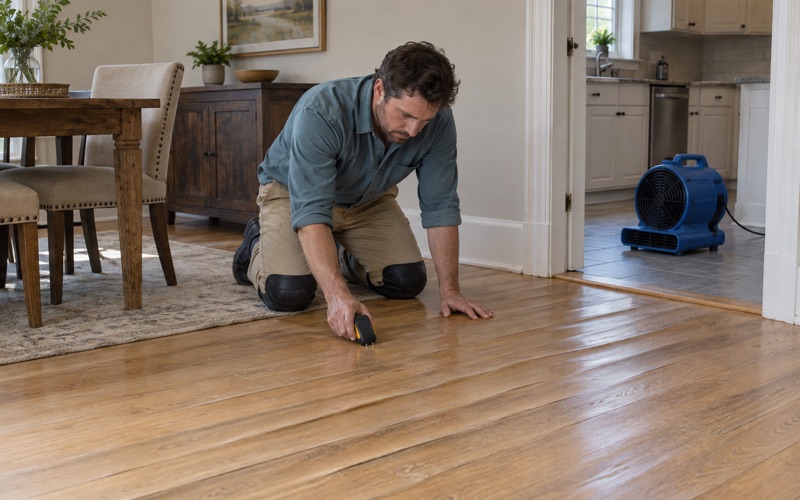
Before new boards go down, we take moisture meter readings of the flooring and the subfloor and let the material reach equilibrium moisture content through acclimation. A proper expansion gap at the walls gives the floor room to move, which helps keep it from buckling or crowning in the seasons ahead.
Species choice for a new floor comes down to traffic and taste. White oak and red oak are the familiar choices for matching older rooms, while hickory and hard maple rank higher on the Janka hardness rating for busy households. Plainsawn, rift sawn and quartersawn boards each show grain differently, and wide plank or herringbone layouts change both the look and the labor.
Water Losses, Smoke and Stairs
When a leak or fire damages a floor, we document it with photos and moisture readings an adjuster can use, then write the repair scope as matching board and finish rather than a patch. Smoke damage often calls for soot cleanup and odor sealing before refinishing can begin.
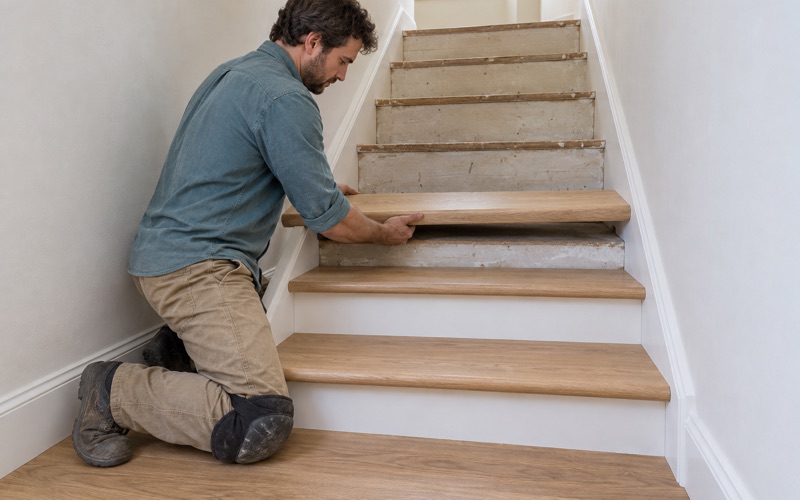
Stairs are quoted on their own terms, by the tread, riser and stair nosing. Stair work is built and priced differently from open floor, so a retrofit tread or landing tread gets its own line on the estimate instead of disappearing into a square-foot figure.
- 20+ Years in Wood Flooring
- Free Written Estimates
- Room-by-Room Schedules