Alhambra Wood Flooring builds and refinishes hardwood stair treads in Alhambra, CA, serving surrounding cities including South Pasadena, San Gabriel, Monterey Park, San Marino and Rosemead. In more than 20 years of wood flooring, stairs have always been handled as their own project, because each step is a small piece of carpentry rather than a patch of open floor.
That is why we quote stairs by the tread, riser and nosing instead of folding them into a square-foot floor price. A staircase can have a dozen or more steps, a landing, skirt boards and an open side with balusters, and each part takes different handwork. Pricing it by component shows exactly what the stairs cost and lets you choose where to spend.
Whether you are pulling up carpet to reveal old treads, replacing worn and cracked steps, or matching stairs to a newly refinished floor, we plan the work around the fact that stairs are usually the only way between floors.
Stair Tread Options
Refinishing Existing Hardwood Treads
Many older stairs have solid hardwood treads under carpet or worn finish. When they are sound and thick enough, we sand them by hand with detail sanders and scrapers, since a floor sander cannot reach a tread’s edges and nosing. The treads are then stained and finished to match the adjoining floor.
Worn traffic paths in the center of each tread are common on older stairs. Most wear sands out, but deep hollows or cracks may make a single tread a better candidate for replacement than for heavy sanding.
New Solid Hardwood Stair Treads
When the existing treads are cracked, loose, too thin or never meant to be seen, new solid hardwood treads are cut to fit each step. Stairs are rarely perfectly square, so each tread is measured and scribed to the skirt boards and stringers rather than cut to a single standard size.
New treads are glued and fastened to the stair structure, which also helps eliminate squeaks. Nosings can be shaped as part of the tread or installed separately depending on the design.
Retrofit Treads Over Existing Steps
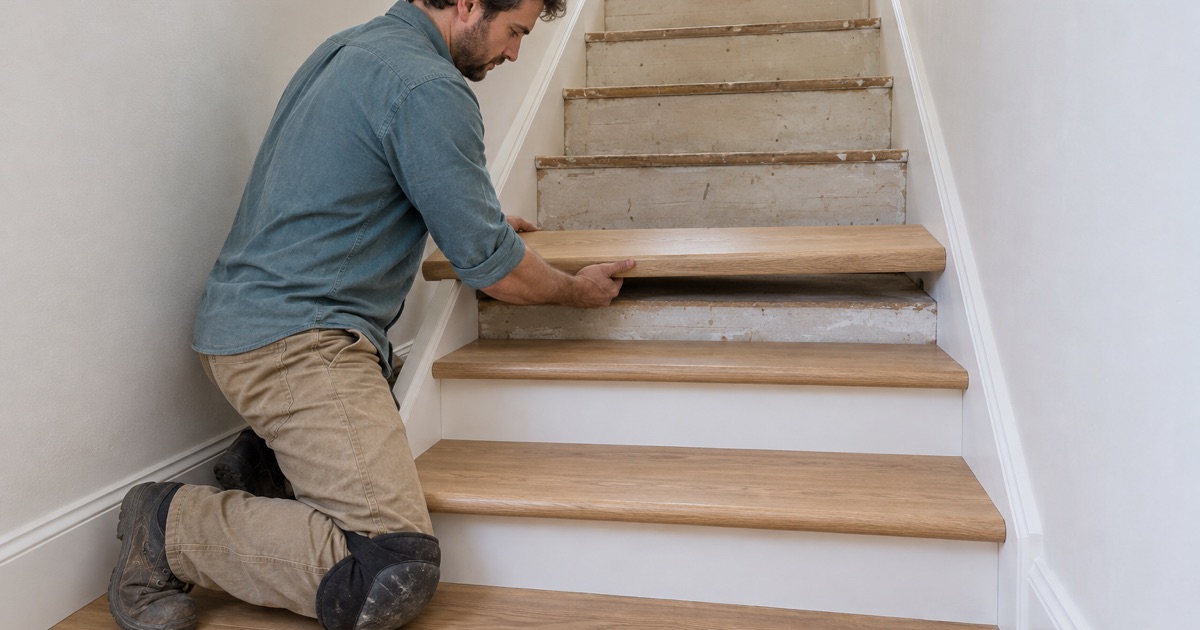
Retrofit treads cap the existing steps without tearing them out, which suits many carpeted staircases with rough treads underneath. The existing nosing is usually cut back flush with the riser, and the retrofit tread and a thin riser cover go on over it.
Because retrofit treads add thickness, the top and bottom steps need attention so every rise stays consistent. We measure the full run before ordering, since uneven step heights are both uncomfortable and a tripping hazard.
Risers, Nosings And Landings
Wood Or Painted Risers
Risers can be finished wood that matches the treads, or painted for contrast. Painted risers are popular because they hide scuffs from toes and give the stairs a crisp, finished edge. Wood risers create a continuous wood look from floor to floor. We price both options so you can compare.
Existing risers are often plain plywood or painted boards in good shape, and painting them again is the least disruptive choice. When risers are damaged, or when a retrofit changes their height, new riser covers are cut for each step and either finished in wood or primed and painted after installation.
Stair Nosing At The Top Step
Where the stairs meet the upper floor, a stair nosing finishes the edge of the flooring. On a refinish, we match the existing nosing to the floor. On a new installation, the nosing is chosen to fit the floor thickness and to align with the edge of the treads below, so the top step reads as part of the staircase.
The top of the stairs is also where transitions between flooring types tend to happen. If the upstairs hall is carpet or tile while the stairs become hardwood, the nosing or a reducer handles that change in height cleanly, so there is no raised lip for a foot to catch on the way down.
Landings And Landing Treads
A landing can be treated as a small floor with a landing tread at its edge, or built with boards running to match the adjoining stairs. We decide the board direction with you, since it affects how the landing connects visually to the rooms at either end.
Landings see concentrated traffic where people turn, so they often wear faster than the steps around them. A landing that is worn but sound can be sanded with the stairs, while one with loose or damaged boards is repaired first so it does not flex under the new finish.
Matching Stairs To The Floors Around Them
Species And Grain Matching
Stairs look best when they read as part of the floor they connect. We match the species, such as red oak, white oak or hickory, and try to match the grain pattern, since a quartersawn or rift sawn floor next to a plainsawn staircase can look mismatched even in the same wood.
Solid stair treads are usually wider and thicker than floor boards, so they are often glued up from several strips. We look at how the strips are arranged in tread stock before ordering, choosing treads whose color and grain sit comfortably next to the floor rather than treads that look like a separate product.
Stain And Finish Across Floors And Stairs
New treads and aged boards absorb stain differently, so we test the color on tread stock before committing. Refinishing the stairs and adjoining floors together is the most reliable way to get one color and sheen from room to staircase. The finish products meet the South Coast air district limit, just as they do on the floors.
Stairs In Pre-1978 Homes
Older staircases often have painted stringers, skirt boards, balusters and risers. In homes built before 1978, that paint may contain lead, and work that disturbs it falls under the federal lead-safe renovation rule. We confirm the build year before starting so the right containment and cleanup are part of the plan.
Planning And Pricing A Stair Project
Priced By Tread, Riser And Nosing
Our estimate lists each component separately: treads to refinish or replace, risers to finish in wood or paint, nosings, landings and any skirt board or stringer work. This makes it easy to adjust the scope, for example replacing treads while keeping painted risers, and see how the price changes.
It also keeps the floor estimate honest. If you are refinishing a living room and a staircase in the same project, the square-foot price for the room is not quietly raised to absorb the stairs, and the stair price is not hidden inside the room.
Keeping The Stairs Usable
Stairs are often the only route to bedrooms, so we plan a sequence that keeps them passable where possible. One method finishes alternating steps first. Your written schedule shows which steps can be used, when, and when the staircase returns to full use.
If a household cannot manage with a partly usable staircase, we can instead finish the whole run at once on a day when upstairs rooms are not needed. We talk through both approaches when we quote, since the right choice depends on who lives in the house.
Squeaks, Loose Treads And Structure
A squeaking or loose tread usually has lost its fastening to the stringer or the riser. We refasten and glue treads where needed before finishing. If a stringer is cracked or the staircase moves noticeably, we assess the structure first, because a new finish will not hold up on stairs that flex.
- 20+ Years in Wood Flooring
- Free Written Estimates
- Room-by-Room Schedules