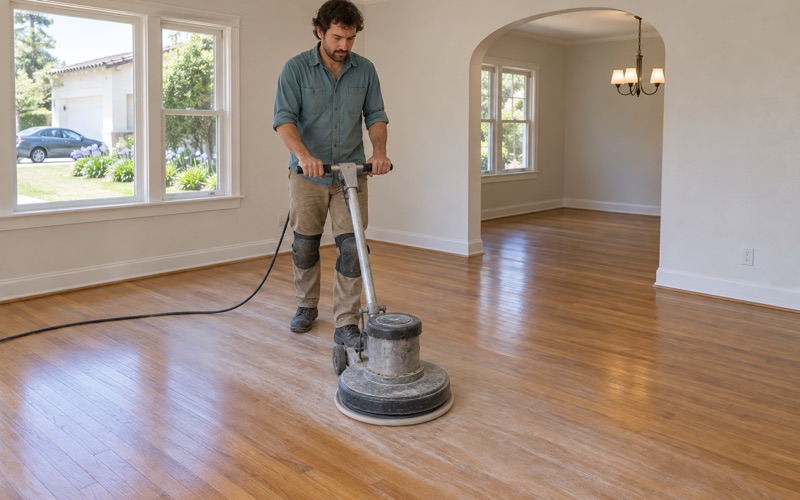
Alhambra Wood Flooring has spent more than 20 years on wood-flooring in Artesia and the surrounding part of southeast Los Angeles County, sanding and refinishing worn floors, replacing damaged boards and installing new solid or engineered hardwood. Much of what we are asked to look at is a floor walked on for decades that now needs a decision: refinish it, repair it or replace it.
That decision starts with measurement rather than a price sheet. On an engineered floor we measure the wear layer before promising a sanding, because a thin veneer can take a screen and recoat but not a full sand. On a solid floor we look at how much wood remains above the tongue, and we check any small round holes or pellet piles for drywood termite activity before a single board comes out.
The sections below cover the houses that make up most of the city, how they came to be there, and why owner-occupied and rented houses often call for different kinds of floor work. The last section explains how we plan a project so a household knows when each room is usable again.
Floors in Artesia’s 1950s and 1960s Tract Houses
What Turns Up Under Carpet and Vinyl
Houses built in the postwar decades often had wood strip floors that were later covered with carpet, sheet vinyl or tile as tastes changed. When an owner lifts a corner and finds oak underneath, the first question is condition: tack strip holes along the walls, staple lines from carpet pad, adhesive residue, and gray stain where moisture sat under a rug for years.
None of that rules out a refinish on its own. Staple holes fill, many adhesives sand off, and a gray stain that sits mostly in the finish layer may lift. A black water stain or a deep pet urine stain that has soaked into the wood fibers usually does not, and those boards are better handled as a board replacement or weave-in repair using matching stock.
How Much Wood Is Left to Sand
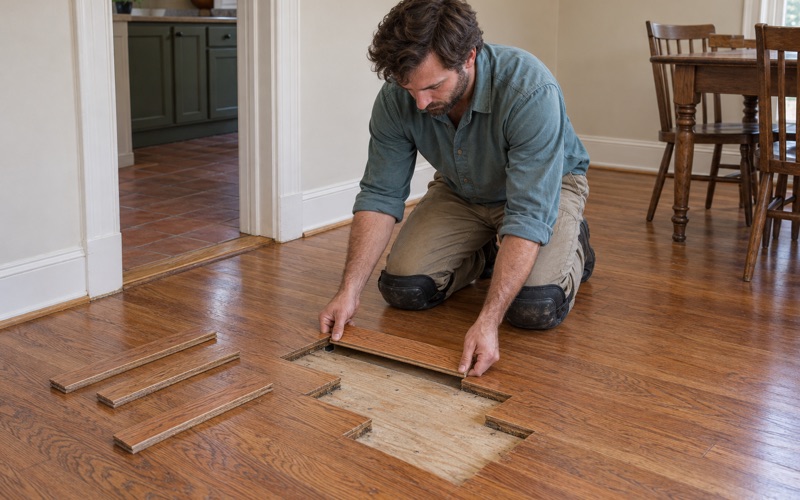
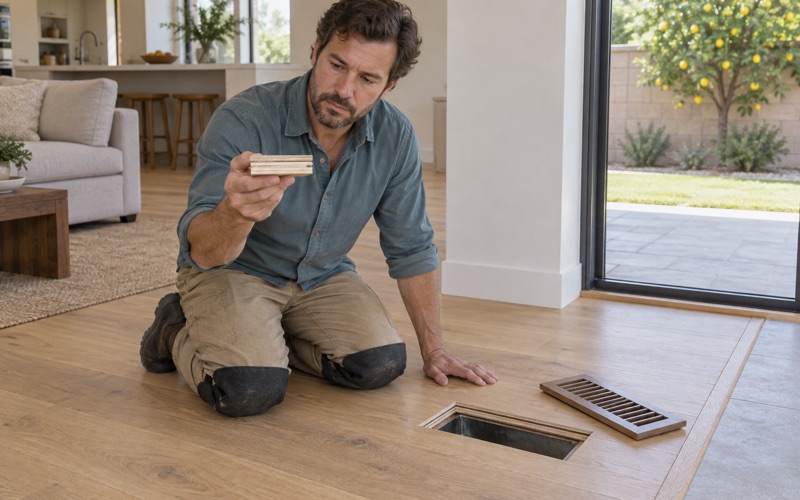
A floor laid in the 1950s or 1960s may already have been sanded two or three times. Each pass removes wood above the tongue and groove, and a floor sanded too thin shows exposed nail heads, splintering edges or a visible tongue. Where we can, we lift a floor register or a threshold to see a board edge before recommending a full sand.
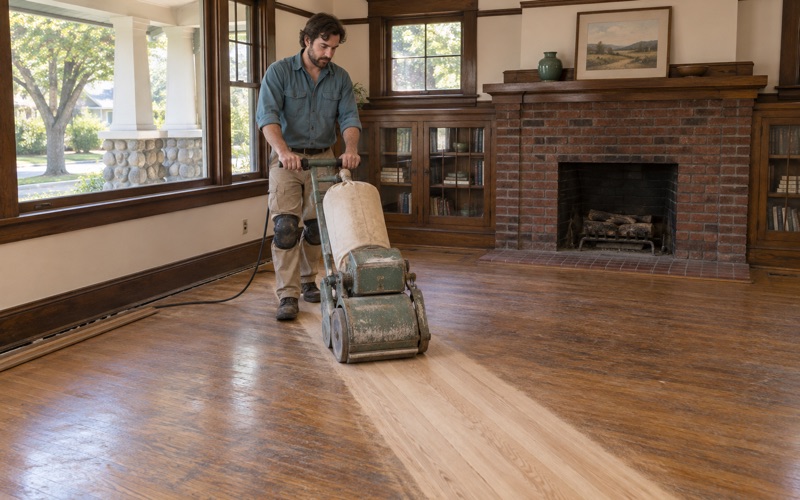
When the wood is thin, a screen and recoat or a buff and coat renews the surface without taking more material. When enough remains, a full sand with a proper abrasive grit sequence removes the chatter marks, drum marks and edger swirl left by earlier work, and it leaves an even base for stain or a clear finish.
Squeaks, Bounce and Sloping Rooms
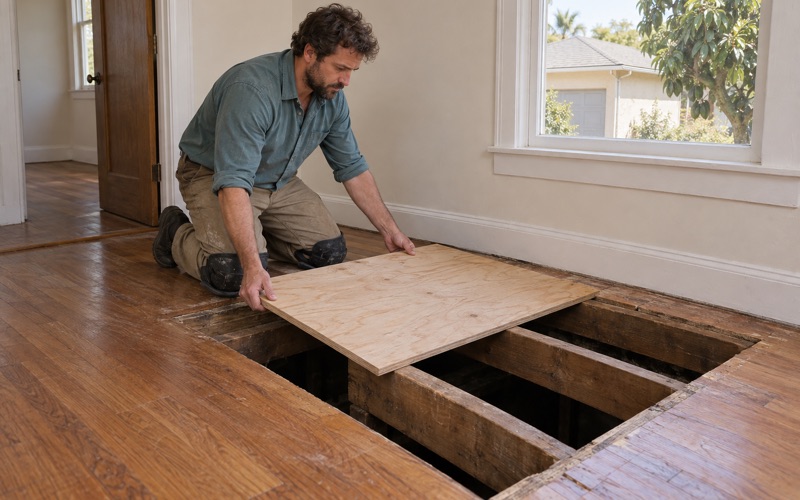
Squeaks, popping, hollow spots and a bouncy floor are common complaints in older houses, and sanding does nothing for any of them. Where the framing under a floor can be reached, we look at it before quoting the floor itself, checking floor joists, girders and posts for movement, gaps or earlier repairs.
A sagging floor or a soft spot is often a joist, post or subfloor problem rather than a flooring problem. Sistering a joist, closing a gap or refastening a loose board subfloor can quiet a room that would otherwise keep moving under a fresh finish. We tell the owner what we find and which part belongs to a framing repair before any floor work is scheduled.
Looking for wood-flooring closer to La Palma? See Wood-Flooring in La Palma.
From Dairy Land to a Detached-House City
The Dairies That Came First
Artesia’s land was farmed long before it was subdivided. Dairymen mainly of Portuguese ancestry arrived from the San Joaquin Valley in the early 1920s, and Dutch dairymen settled in the same decade; the Artesia Reformed Church formed in 1932. For a generation the area was known for milk production rather than housing.
After World War II, developers pressed for residential tracts, and the dairies relocated to Chino and the Central Valley. The city incorporated on May 29, 1959, in the middle of that change. Land that had held dairies filled in with residential streets across the city’s 1.62 square miles, and that build-out still shapes the floors we are asked about today.
What the Census Counts Show
The American Community Survey 2024 five-year estimates count 4,727 housing units in Artesia, and 3,215 of them, 68.0 percent, are one-unit detached houses. The build years line up with the dairy history: 1,121 units date from the 1950s and 1,149 from the 1960s, together 48.0 percent of the housing stock.
Counting the 1970s as well, 76.2 percent of units were built before 1980, while only 9.7 percent date from 2000 or later. A house that age has usually been through more than one finish, and sometimes more than one floor covering, which is why we ask about a floor’s history before recommending anything.
Build Year and Older Finish Layers
Because so much of the city predates 1978, we confirm the build year before any sanding is scheduled. Paint on baseboards and older finish layers in pre-1978 housing can contain lead, and disturbing that work is handled under the EPA Renovation, Repair and Painting Rule.
That rule affects setup more than the finished look. It shapes dust containment, how shoe molding and quarter round are removed and reinstalled, and how cleanup is done at the end of each day. Dustless sanding equipment helps with ordinary dust, but it does not replace the work practices that apply to an older house.
Owner-Occupied Houses and Long-Term Refinishing
Owners Living in Detached Houses
Owners make up 49.5 percent of Artesia’s occupied households, and 2,034 of those 2,235 owner households, 91.0 percent, live in detached houses. An owner planning to stay can weigh a floor over many years rather than until the next move, and that changes which option makes the most sense.
For a solid oak floor with plenty of wood left, a full sand and fresh finish can be followed by a screen and recoat every few years, before the finish wears through in traffic lanes. Catching a worn-through finish early keeps gray stain out of doorways and hallways, and it saves sanding depth for the refinish after that.
Owners also use a refinish to change color. Stain reads warmer on red oak than on white oak, and the way the wood is prepared affects how evenly color takes. We lay test patches in the room itself, under that room’s light, before the whole floor is committed to one shade.
Finishes Allowed in the South Coast Air District
Artesia sits within the South Coast Air Quality Management District, which limits volatile organic compounds in coatings under SCAQMD Rule 1113. Its wood coatings limit is 275 grams per liter, so we choose finishes from products legal to apply here rather than from a national catalog.
Within that limit, waterborne polyurethane dries clear and allows a shorter recoat window, while compliant oil-modified products and hardwax oil give a different look and a different maintenance routine. We explain cure time and sheen level for each option so an owner can pick a finish that suits how the room is actually used.
Adding New Wood to an Older House
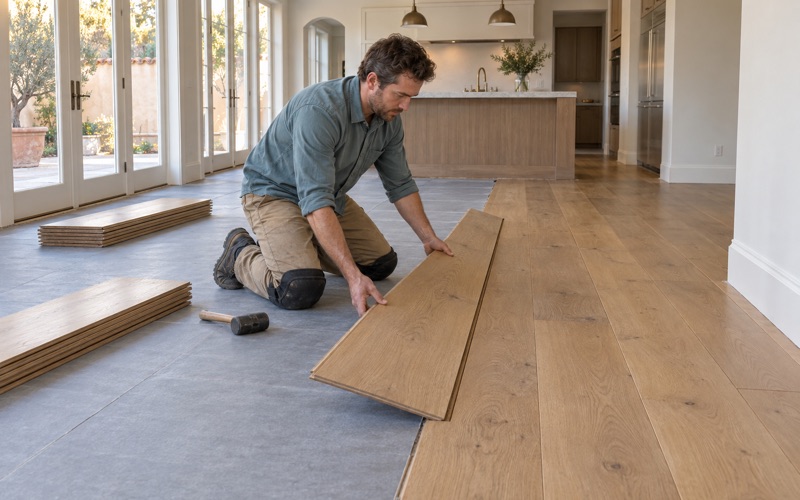
When an owner wants new flooring rather than a refinish, the choice is usually between solid hardwood and engineered hardwood. Solid white oak or red oak can be sanded several times over its life, while an engineered plank with a thick wear layer offers more dimensional stability. A Janka hardness rating helps compare species such as hickory or hard maple for a busy household.
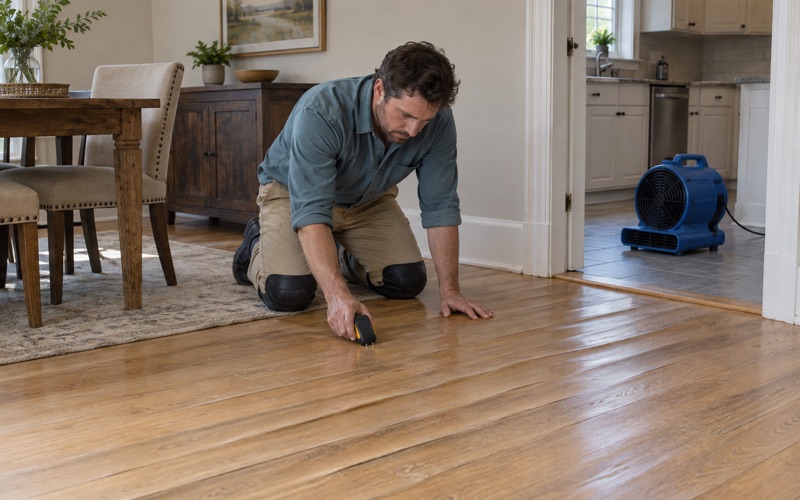
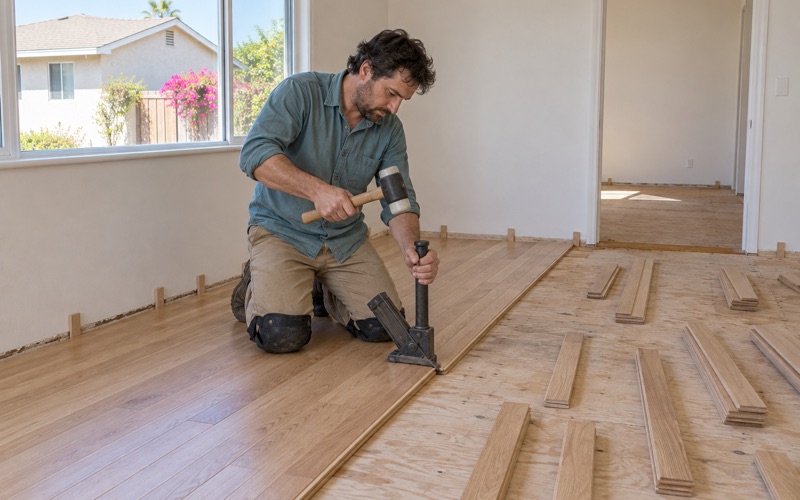
New wood also has to acclimate before it goes down. We take moisture meter readings of the flooring and the subfloor, leave an expansion gap at the walls, and follow the manufacturer’s fastener spacing schedule for a nail-down installation or its adhesive instructions for a glue-down installation. Skipping those steps is how a new floor ends up cupping, crowning or buckling.
Rented Houses and Planning a Project
Rented Houses on the Same Streets
Renters make up 50.5 percent of Artesia’s occupied households, and 1,116 renter households, 49.0 percent of all renters, live in detached houses. Of the 3,150 occupied detached houses in the city, 35.4 percent are rented, so a rented house can sit right beside one its owner has lived in for decades.
For a rental, we schedule the work around the move-out and move-in dates and record the floor condition on both sides of the tenancy with dated photos. That gives the owner a clear record of what changed, whether the job is a quick screen and recoat between tenants or a full refinish while the house stands empty.
A Written Schedule, Room by Room
We write out a room-by-room schedule showing when each space can take foot traffic, when furniture can return, and when rugs and pets can come back. Rugs generally wait longer than furniture, because a new finish needs air while it cures, and a household or incoming tenant can plan around those dates.
Seasonal humidity plays a part too. Artesia falls within the National Weather Service forecast zone for the Los Angeles County inland coast, and wood moves as relative humidity shifts through the year. Some seasonal gapping between boards is normal, so we read moisture levels before filling gaps that may close again on their own.
Stairs, Damage and the First Visit
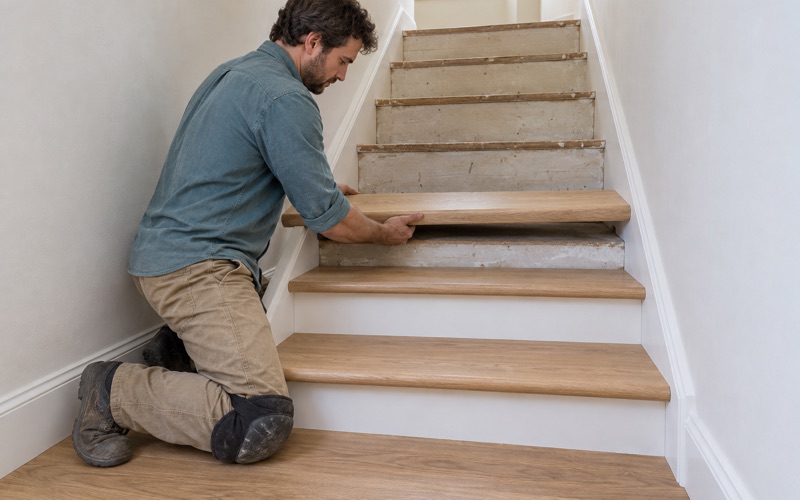
Stairs are quoted separately, by the stair tread, riser and stair nosing, because stair work is built and priced differently from open floor. Before we replace a board anywhere in the house, we check kick-out holes and piles of termite frass, so a new board does not go down over an active drywood termite colony.
When a floor was damaged by a leak or smoke, we document the loss with photos and moisture readings an adjuster can use. The repair scope is written as matching board species, width and finish rather than a patch, so the repaired area does not stand out once the room is refinished.
Before we visit, it helps to know the build year, any past refinishing, and which rooms have carpet or vinyl over wood. The City of Artesia provides Building and Safety services through a contract with BPR Consultants, with an office at 18747 Clarkdale Avenue, and that office is where an owner asks what a project reaching into framing requires.
- 20+ Years in Wood Flooring
- Free Written Estimates
- Room-by-Room Schedules